Missing tiles, cracked slates, failed flashings or a leaking ridge — we diagnose accurately, quote honestly and fix it right first time. No call-out fee, no hidden extras.
Roof repairs in Reading cost £150-£900 depending on the fault — slipped tiles, failed flashings, valley leaks or ridge damage. We diagnose the actual cause from roof level, quote in writing, and carry common tile profiles for same-day fixes. Free survey, no call-out fee. Call 0118 327 2383.
✓ NFRC Registered
✓ Fully Insured
✓ 10 Year Guarantee
✓ Free Quotes
✓ No Hidden Costs
✓ Family Run Since 2003
Roof Repair Specialists
Roof Repair Services in Reading
Reading's varied housing stock — from Georgian buildings in the town centre to 1960s estates in Whitley — demands a roofer who knows different tile types, failure modes and repair approaches. We've worked on all of it.
Victorian and Edwardian properties in Newtown and Katesgrove typically need lead flashing work around chimney stacks and abutments, along with occasional clay plain tile sourcing where originals have been broken. The challenge on these properties is matching the original clay — we source secondhand stock where possible to avoid visual patchwork on prominent street elevations.
On 1960s–70s concrete tile estates in Whitley and Southcote, the primary issue is nail sickness: the original cut nails used to fix concrete interlocking tiles have corroded to the point where tiles are held only by their weight and neighbouring tiles. We identify the extent of nail failure, quantify the affected area, and advise on whether targeted repairs or a phased re-roof makes more economic sense.
The 1930s semis across Tilehurst and along Caversham Road represent a large and frequently visited part of our work. Concrete plain tiles on these properties are often still sound but mortar beds on ridge and hip lines fail after 40–50 years. Flexible mortar re-bedding with dry-fix verge systems is the recommended repair — it lasts significantly longer than traditional sand and cement on exposed ridges.
“Three tiles had slipped on the front bay of our Edwardian semi. They matched the original clay tiles exactly — you can't tell which ones were replaced. Perfect job.”
Patricia L. · Church Road, Caversham RG4
★★★★★
“Called about a chimney flashing issue that had been causing a drip into the bedroom for two years. Found the source immediately and replaced the lead counter flashing. No more drip. Should have called sooner.”
Robert M. · Tilehurst RG31
★★★★★
“Had the ridge repointed on our 1930s semi. They used a flexible mortar compound and explained why it's better on an exposed ridge. Very thorough and priced fairly.”
The range of work that falls under 'roof repairs' in Reading is wide — from a single displaced clay tile on a Newtown Victorian terrace to a complex lead flashing and valley replacement on an Edwardian Caversham property. What these jobs have in common is that they require a physical survey to establish the actual scope before a price can be honestly quoted.
The most common repair categories we encounter across Reading, by frequency: individual or section tile replacement on nail-sick concrete tile estates (Whitley, Southcote, Woodley, Earley); lead flashing repair and replacement on Victorian and Edwardian properties in Newtown, Katesgrove and Caversham; ridge and hip tile repointing and dry-fix conversion across the 1930s housing stock in Tilehurst and Emmer Green; flat roof patch and membrane repair on estate garage and extension roofs; and chimney repointing and haunching repair across all housing eras.
We do not provide indicative prices without surveying the property. The range of outcomes for a 'roof repair' in Reading starts at £150 for a single tile replacement and runs to £2,000 for a comprehensive valley and flashing replacement on a period property. The only way to determine where your specific job sits in that range is to inspect it from the roof.
How much do roof repairs cost in Reading?
Roof repairs in Reading typically cost £150-£300 for a slipped tile, £280-£800 for lead flashing, and £400-£1,200 for valley work. See our full Reading roof repair cost guide for a detailed breakdown by fault type and area.
On Reading's post-war concrete-tile estates, cracked and falling verge mortar is a common repair. We fit maintenance-free dry verge systems for Reading estates.
Honest advice
Do You Actually Need Roof Repairs?
Most Reading roof problems announce themselves indoors first — a stain, a drip, a patch of damp — long before the cause is visible from the ground. The trick is tracing the symptom back to the actual fault.
A damp patch or brown stain on an upstairs ceiling after rain
A slipped, cracked or missing tile visible from the ground
Water tracking down a chimney breast or around a rooflight
Debris (mortar, tile fragments) in the gutters or on the drive
Daylight visible through the roof from inside the loft
When it is not the answer: If more than about a third of the covering has failed — widespread nail sickness on a 1960s-70s Whitley or Southcote estate roof, for instance — repairing tile-by-tile is money wasted. Read the full guide.
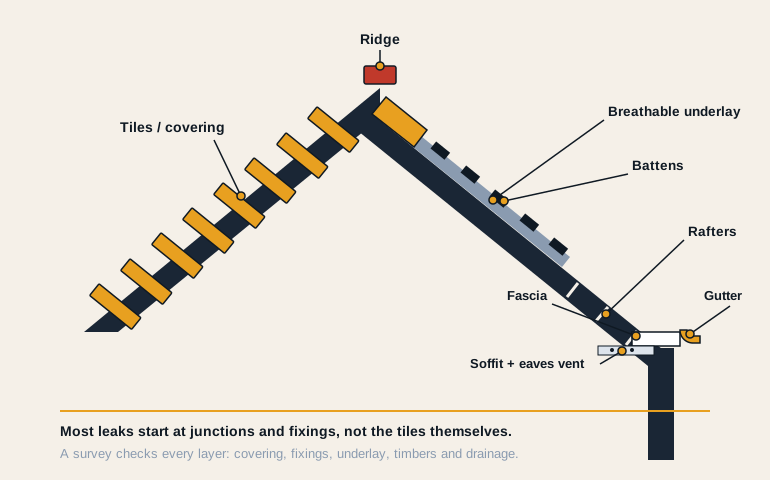
We inspect from roof level, lift sample tiles to check the fixings and underlay, and trace the leak to its real source — not the nearest visible symptom.
2. Written itemised quote
You get a fixed, written price naming the fault, the fix and the guarantee — no lump-sum guesswork.
3. Scheduling
We agree a date; for common faults we carry matching materials to fix on the first visit.
4. The repair
We carry out the work, document any hidden damage found with photos, and make the roof weathertight.
5. Cleanup & sign-off
We clear debris, leave the site tidy, and hand over the written workmanship guarantee.
Timescales
Typical Timescales
Job
Typical duration
Slipped or cracked tile refix
1-2 hours
Lead flashing repair
Half a day
Section of nail-sick tiles refixed
Half to full day
Rear valley rebuild
1-2 days
Chimney flashing renewal
1 day
Wet or high-wind days pause tiling and lead work — we build weather margin into every booking and never leave a roof open overnight.
Access
Access, Scaffolding & Permits in Reading
Most Reading repairs run from roof ladders or a tower; scaffold is quoted only where the job needs safe standing time at height. Scaffold is specified for: chimney-side repairs, full valley rebuilds, ridge work on exposed Tilehurst and Caversham Heights streets, or anything beyond a day at height - always itemised in your written quote, never a hidden extra, and we arrange it.
Reading's mix of Victorian terraces in Newtown and Katesgrove and post-war estate housing in Whitley and Lower Earley means access varies from tight terraced frontages to open estate driveways. Pavement scaffold and skip permits go through Reading Borough Council; allow a few working days on streets like Newtown terraces off the Oxford Road, the narrow streets of Katesgrove where space is tight.
Pricing
What Roof Repairs Costs in Reading
Job
Typical range
Notes
Slipped or cracked tile refix
£150-£300
Per visit incl. access
Lead flashing repair / renewal
£280-£800
Chimney or abutment
Section of nail-sick tiles refixed
£300-£600
Signals wider issue
Valley renewal
£400-£1,200
Depending on length
Ridge repointing (per run)
£300-£1,000
Exposed stock weathers faster
Emergency make-safe call-out
£150-£450
Same-day, stated up front
What moves the price
Roof height and access (bungalow vs three-storey terrace)
Whether the tile needs matching (clay in Newtown/Caversham costs more than concrete)
Scaffold vs tower vs ladder for the specific fault
How far the leak has tracked before it was caught
Hidden timber rot found once tiles are lifted
Worked example: A rear valley rebuild on a 1930s semi off the Wokingham Road, concrete tile, tower access: around £680 including access and waste removal.
No deposit on repairs under £500. Staged payments on larger jobs — nothing up front before materials are on site. All prices include VAT.
Guarantee
What the 10-Year Guarantee Actually Covers
Workmanship on the repaired section is covered for 10 years in writing; any replacement tiles and lead carry manufacturer warranties on top.
Covered: workmanship for 10 years, in writing, transferable if you sell.
On top: manufacturer warranties on materials (terms vary by product).
Not covered: storm or impact damage - that is an insurance matter, and we will document it for your claim.
If a fault appears in covered work, we come back and put it right. No quibbling, no re-charge.
A day of ladder or tower work and a small amount of tile debris — we sheet below the work area and clear everything before we leave. You do not need to stay home for external work - we just need power and access agreed in advance.
Repairs run year-round; temporary weatherproofing goes on the same day if rain stops work mid-job. Thames Valley humidity and the Kennet and Thames river corridors slow drying and accelerate moss, especially on north-facing slopes.
FAQ
Common Questions
Tile replacements and minor flashing repairs typically cost £150–£350 in Reading. Ridge repointing on a 3-bed semi is usually £300–£600. Lead valley replacements run £400–£900 depending on length. We provide free itemised quotes so you know exactly what you're paying.
Yes. We regularly source secondhand and reclaimed clay plain tiles to match the original profile and weathering on Reading's Victorian and Edwardian properties. For prominent street elevations in conservation areas, like-for-like matching is often required by planning guidance, and we know the local suppliers.
Nail sickness is the corrosion of the original iron or mild steel nails used to fix roof tiles, most commonly on concrete interlocking tile roofs built in the 1960s and 1970s. It's common across Reading's post-war estates in Whitley, Southcote and parts of Woodley. Affected tiles are held only by weight and contact with neighbouring tiles — a risk in high winds.
A well-executed repair should last 10–20 years depending on the material and scope. Lead work done correctly lasts 50+ years. Mortar ridge repointing with flexible compound lasts 20–30 years. We won't carry out repairs we don't expect to hold — if the underlying condition requires more than a repair, we'll tell you.
A well-executed repair using correct matching materials should last as long as the surrounding roof — 20 to 40 years on concrete tile stock, indefinitely on sound clay or slate. Repairs failing within a few years are almost always the result of wrong materials or addressing the symptom rather than the cause. We guarantee all repair work for 5 years as standard.
Yes. We hold stocks of reclaimed clay plain tiles in common Reading profiles and source matching clay from specialist suppliers for less common sizes. For Newtown and Katesgrove properties with original handmade clay tiles, we source from reclamation yards. Conservation area properties often require specific profiles — we advise before any work starts.
Keeping your roof in good repair is a condition of most home insurance policies. A repaired roof is less likely to generate a declined claim than a neglected one. We can provide a written record of repairs carried out, which is useful evidence if you ever need to demonstrate maintenance history to an insurer.
Areas Covered
We Cover All of Reading
Based in Reading, we serve the whole borough and surrounding Berkshire towns. Call 0118 327 2383 to confirm coverage.
Every roof repair we carry out begins with a physical inspection from roof level — not a visual assessment from the ground. We lift sample tiles to check nail and batten condition, probe mortar for hidden deterioration, and physically test lead flashings for movement. This takes longer than a pavement-level quote but it means the repair addresses the actual cause rather than the visible symptom.
We provide a written, itemised quote before any work starts. The quote specifies what will be done, what materials will be used by name and grade, and what the workmanship guarantee covers. We do not begin work until you have accepted the quote in writing. There are no verbal agreements on price that can be reinterpreted later.
For repairs on occupied properties, we confirm the programme the morning of the work and leave the property weathertight each day before we depart. If a repair identifies additional underlying issues — degraded felt underlay visible once tiles are lifted, rotten batten sections — we photograph the finding and discuss options before proceeding. No hidden extras.
Materials and Specification
Material matching is the most important technical decision on any roof repair. Replacing a clay plain tile with a concrete interlocking tile — or the wrong clay profile — creates drainage problems at the junction and is visually obvious from the street. We hold matching stock for the most common Reading tile profiles and source less common profiles from specialist suppliers within 24 to 48 hours.
For mortar-bedded elements — ridge tiles, verge details, chimney haunching — we use a flexible polymer-modified mortar on post-1950 properties, and lime-based mortar on pre-1940 properties where the original brickwork requires it. Using cement-based mortar on lime-bonded Victorian brickwork causes spalling; this is one of the most common causes of deterioration we find on Newtown and Katesgrove terraces that have been previously worked on by contractors unfamiliar with period materials.
Get In Touch
Get Your Free Quote Today
No call-out fees. No obligation. A straight answer from a local Reading roofer.