Storm damage to your roof needs immediate attention — not because of the visible tile loss, but to prevent water tracking into the property before you see it from inside. We attend the same day across Reading and provide written reports for insurance claims.
Storm damage roof repair in Reading gets same-day response with ETA confirmed within 30 minutes. We secure falling hazards, make the roof weathertight, and provide written insurance reports the same day. Exposed ridge areas see the most damage. Call 0118 327 2383 now.
✓ NFRC Registered
✓ Fully Insured
✓ 10 Year Guarantee
✓ Free Quotes
✓ No Hidden Costs
✓ Family Run Since 2003
Storm Damage Specialists
Storm Damage Roof Repair in Reading
Reading's exposed western and elevated locations — Tilehurst ridge, Caversham Heights, Pangbourne Downs — are disproportionately affected in major storm events. We provide same-day emergency response, make-safe tarping and permanent repairs, and written insurance damage reports.
Don't wait to assess the extent yourself. Call 0118 327 2383 and describe what you can see from ground level. We'll advise on urgency and confirm arrival time.
02
Same-Day Attendance
For active leaks or structurally compromised roofs, we aim to attend the same day. We arrive with materials for common emergency repairs and temporary cover.
03
Safe and Dry Fast
Priority is making the property weathertight — either through permanent repair on the day or EPDM temporary cover where full repair requires a return visit.
04
Insurance Report
We provide written storm damage reports with photographs on request. Accepted by major UK insurers and useful for your claim documentation.
Customer Reviews
Reading Homeowners Recommend Us
★★★★★
“Storm took three ridge tiles off and cracked a section of the valley lead. Called at 8am, they were here by 11am, made everything safe and had it fully repaired by 2pm the same day. Excellent response and the insurance report they produced was exactly what the claim needed.”
Barbara F. · Caversham Heights, RG4
★★★★★
“Large section of concrete tiles lifted overnight in January. Cold air coming through into the loft and we could see daylight. Reading Roofing came the next morning, tarped the exposed section immediately and returned two days later for the permanent repair. Exactly what you need from an emergency service.”
David K. · Whitley, Reading RG2
★★★★★
“Storm damage claim — they came out, assessed everything, repaired the roof and gave us a detailed written damage report within 24 hours. Insurer accepted it without question. Efficient and professional.”
Reading's position in the Thames Valley means it sits in the path of south-westerly Atlantic weather systems moving north-east across southern England. Storm events affecting the Reading area typically originate in the Bay of Biscay or the North Atlantic and arrive with the most energy when the jet stream is positioned over the UK. The exposed ridge suburbs — Tilehurst, Emmer Green, Caversham Heights, Norcot — receive this weather first and at higher wind speeds than the valley floor properties below.
Post-storm call patterns in Reading are predictable by area. Within 24 hours of a named storm event, calls from Tilehurst ridge streets and Caversham Heights typically spike first — these are the exposed elevated properties where displacement risk is highest. Within 48 to 72 hours, calls from the nail-sick estate suburbs begin — Whitley, Southcote, Woodley — as homeowners notice displaced tiles on properties that were already at failure threshold.
We maintain emergency response capacity year-round but increase it between October and March when storm frequency peaks. During major storm events affecting multiple properties simultaneously, we prioritise calls based on active water ingress and structural safety risk. If you are calling after a storm and have no current water ingress but want a damage assessment, we will book you in for a survey visit as soon as our emergency queue clears — typically within 24 to 48 hours of the storm event.
Honest advice
Do You Actually Need Roof Repairs?
Most Reading roof problems announce themselves indoors first — a stain, a drip, a patch of damp — long before the cause is visible from the ground. The trick is tracing the symptom back to the actual fault.
A damp patch or brown stain on an upstairs ceiling after rain
A slipped, cracked or missing tile visible from the ground
Water tracking down a chimney breast or around a rooflight
Debris (mortar, tile fragments) in the gutters or on the drive
Daylight visible through the roof from inside the loft
When it is not the answer: If more than about a third of the covering has failed — widespread nail sickness on a 1960s-70s Whitley or Southcote estate roof, for instance — repairing tile-by-tile is money wasted. Read the full guide.
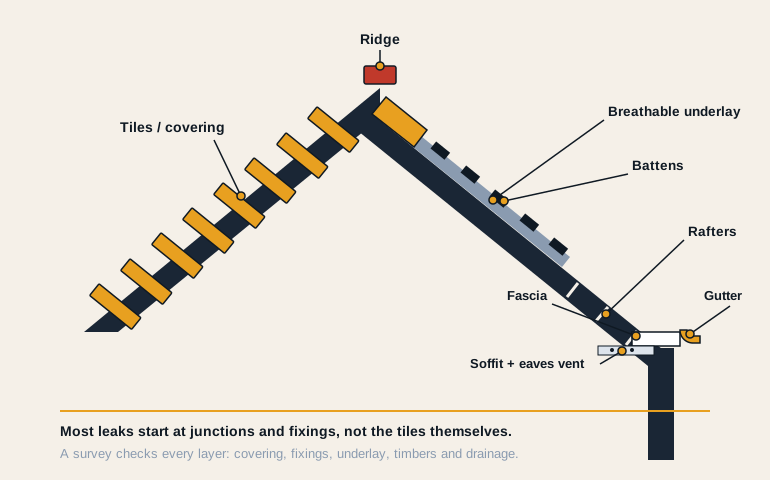
We inspect from roof level, lift sample tiles to check the fixings and underlay, and trace the leak to its real source — not the nearest visible symptom.
2. Written itemised quote
You get a fixed, written price naming the fault, the fix and the guarantee — no lump-sum guesswork.
3. Scheduling
We agree a date; for common faults we carry matching materials to fix on the first visit.
4. The repair
We carry out the work, document any hidden damage found with photos, and make the roof weathertight.
5. Cleanup & sign-off
We clear debris, leave the site tidy, and hand over the written workmanship guarantee.
Timescales
Typical Timescales
Job
Typical duration
Slipped or cracked tile refix
1-2 hours
Lead flashing repair
Half a day
Section of nail-sick tiles refixed
Half to full day
Rear valley rebuild
1-2 days
Chimney flashing renewal
1 day
Wet or high-wind days pause tiling and lead work — we build weather margin into every booking and never leave a roof open overnight.
Access
Access, Scaffolding & Permits in Reading
Most Reading repairs run from roof ladders or a tower; scaffold is quoted only where the job needs safe standing time at height. Scaffold is specified for: chimney-side repairs, full valley rebuilds, ridge work on exposed Tilehurst and Caversham Heights streets, or anything beyond a day at height - always itemised in your written quote, never a hidden extra, and we arrange it.
Reading's mix of Victorian terraces in Newtown and Katesgrove and post-war estate housing in Whitley and Lower Earley means access varies from tight terraced frontages to open estate driveways. Pavement scaffold and skip permits go through Reading Borough Council; allow a few working days on streets like Newtown terraces off the Oxford Road, the narrow streets of Katesgrove where space is tight.
Pricing
What Roof Repairs Costs in Reading
Job
Typical range
Notes
Slipped or cracked tile refix
£150-£300
Per visit incl. access
Lead flashing repair / renewal
£280-£800
Chimney or abutment
Section of nail-sick tiles refixed
£300-£600
Signals wider issue
Valley renewal
£400-£1,200
Depending on length
Ridge repointing (per run)
£300-£1,000
Exposed stock weathers faster
Emergency make-safe call-out
£150-£450
Same-day, stated up front
What moves the price
Roof height and access (bungalow vs three-storey terrace)
Whether the tile needs matching (clay in Newtown/Caversham costs more than concrete)
Scaffold vs tower vs ladder for the specific fault
How far the leak has tracked before it was caught
Hidden timber rot found once tiles are lifted
Worked example: A rear valley rebuild on a 1930s semi off the Wokingham Road, concrete tile, tower access: around £680 including access and waste removal.
No deposit on repairs under £500. Staged payments on larger jobs — nothing up front before materials are on site. All prices include VAT.
Guarantee
What the 10-Year Guarantee Actually Covers
Workmanship on the repaired section is covered for 10 years in writing; any replacement tiles and lead carry manufacturer warranties on top.
Covered: workmanship for 10 years, in writing, transferable if you sell.
On top: manufacturer warranties on materials (terms vary by product).
Not covered: storm or impact damage - that is an insurance matter, and we will document it for your claim.
If a fault appears in covered work, we come back and put it right. No quibbling, no re-charge.
A day of ladder or tower work and a small amount of tile debris — we sheet below the work area and clear everything before we leave. You do not need to stay home for external work - we just need power and access agreed in advance.
Repairs run year-round; temporary weatherproofing goes on the same day if rain stops work mid-job. Thames Valley humidity and the Kennet and Thames river corridors slow drying and accelerate moss, especially on north-facing slopes.
FAQ
Storm Damage Questions
First, stay safe — do not attempt to access the roof yourself. Photograph the visible damage from ground level for your insurance claim. If water is entering the property, place buckets and move valuables away from the affected area. Call us on 0118 327 2383 — we provide same-day emergency attendance and can make the roof safe with a temporary cover or repair the same visit if materials allow.
Most building insurance policies cover storm damage to roofs. You'll need to demonstrate the damage was caused by the storm event rather than pre-existing deterioration, which is why documenting the damage promptly and accurately matters. We provide written damage reports on request which are accepted by most major UK insurers. We don't work directly with insurers but can support your claim with evidence.
For active leaks or structurally compromised roofs we aim to attend the same day. During major storm events affecting multiple properties, response times may extend to next day — call immediately rather than waiting to see how bad it is. Early attendance limits interior water damage.
The most common storm damage calls we receive across Reading are displaced ridge tiles (particularly on exposed Tilehurst ridge and Caversham Heights properties), slipped or lifted concrete tiles on post-war estates in Whitley and Southcote, damaged chimney pots and displaced cowls, and torn or lifted sections of felt underlay visible at eaves after high winds. Valley and gutter damage from debris is also common after storms with heavy rainfall.
Check from ground level: look along the ridge for displaced or missing ridge tiles, scan the slopes for lifted or absent tiles, check gutters and ground for debris, and look at the chimney stack for shifted pots or mortar loss. Inside, check the loft for new daylight penetration or damp patches on the felt. If in doubt, call us — we assess without charge.
Make the building safe first — call us for emergency attendance. Photograph all damage before anything is moved. Your building insurer should cover structural damage to your property regardless of who owned the tree. Your insurers handle the liability question — not something to resolve before the emergency is dealt with.
We produce written reports with photographs at the time of the emergency visit and issue them within 24 hours. The report covers the cause of damage, materials affected, extent of water ingress risk, and the scope of permanent repair required. Most major UK home insurers accept our reports without further assessment.
Our Approach
Storm Damage Response in Reading
Storm damage call-outs in Reading follow a clear pattern by property type and location. The Tilehurst ridge streets — Norcot Road, School Road, Kentwood Hill — generate the highest post-storm call density in the Reading catchment because the exposed ridge position amplifies wind speed relative to the valley floor. Emmer Green and Caversham Heights are next in the exposure hierarchy. Lower-lying estates in Whitley, Earley and Southcote generate storm call-outs predominantly from nail-sick concrete tile that was already at the point of failure before the storm and is displaced by wind.
On arrival at a storm-damaged property in Reading, we assess the roof from the ground first to identify any tiles presenting an immediate falling hazard before accessing the roof. Displaced ridge tiles weighing four to seven kilogrammes each can fall from 8 to 10 metres — this is a life-safety risk that takes priority over everything else. We secure falling hazards before beginning any detailed survey.
Temporary repair means getting the building weathertight. For small breaches, we replace individual displaced tiles if matching stock is available. For larger breaches — a section of tiles stripped by uplift, a ridge run that has completely shifted — heavy-duty polyethylene sheeting is fixed from the ridge and weighted at the eaves as an immediate measure, with the permanent repair either completed same-day or confirmed for the following morning.
Insurance Claims and Documentation
Most standard home insurance policies cover storm damage to roofs. The practical requirements for a successful claim are: evidence the damage was caused by the storm event rather than pre-existing deterioration, prompt reporting to the insurer, and evidence that you took reasonable steps to prevent further damage — which the emergency call-out fulfils. We provide written damage reports with timestamped photographs on the same day as the emergency visit, formatted to the standard required by major UK home insurers.
Where insurers appoint a loss adjuster, our written report is typically sufficient to support the claim without a second inspection. Where the adjuster wants to visit independently, we make the property and roof available at a time that works for both parties. We have experience working with all major UK home insurers and can advise on the documentation they typically request.
Get In Touch
Free Quote — No Obligation
No call-out fees. A straight answer from a local roofer who knows Reading.