Active leak? We find the source and fix it. Same-day response across Reading and Berkshire — no call-out fee, free diagnosis, work quoted before it starts.
A leaking roof in Reading needs two things done correctly: accurate diagnosis of the actual source, and a repair that addresses the cause rather than the symptom. Most persistent leaks we encounter in Reading have been "repaired" once or twice already with mortar applied to flashings, putty pressed into cracks, or tiles replaced without checking the underlying cause. The leak returns within a year.
The most common sources of roof leaks on Reading properties, in order of frequency:
Failed lead flashings at chimney stacks and abutments — especially on Victorian and Edwardian stock in Newtown, Katesgrove and Caversham
Blocked valleys — moss and leaf debris causes water to back up under tiles; accelerated by Reading's Thames Valley humidity
Nail sickness on 1960s–70s concrete tile estates in Whitley, Southcote and Lower Earley — tiles lift in wind, water enters via the tile joints
Degraded flat roof membranes on extensions and garages across Woodley, Earley and the post-war estate suburbs
Ridge mortar failure — particularly on exposed ridge-top properties in Tilehurst and Emmer Green
⚠ If water is near electrical fittings, turn off that circuit at the consumer unit before touching anything. Then call us on 0118 327 2383.
How We Diagnose a Leak
We get onto the roof. There is no substitute. A visual inspection from the ground and a loft check with a torch gives context, but the actual source requires physical inspection of flashings, valleys, tile fixings and flat roof membranes at roof level. We trace the water path from the visible internal damp back to the entry point — which is often several metres away from where the water appears inside.
“Water coming through the kitchen ceiling at 8am. Called, someone arrived by 11, traced the leak to a blocked valley and repaired it same day. No drama, no inflated emergency pricing. Exactly the response you need.”
Rachel P. · Caversham, RG4
★★★★★
“Persistent drip through the loft that three people couldn't find. Your team traced it to a failed lead soaker behind a chimney stack that was invisible without lifting the tiles. Fixed in a single visit. The diagnosis was the key.”
Stuart M. · Tilehurst, RG31
★★★★★
“Flat roof on the kitchen extension started leaking after heavy rain. EPDM patch applied within 24 hours, full replacement booked for the following week. Professional from start to finish.”
Linda K. · Woodley, RG5
Leaking Roof Diagnosis in Reading
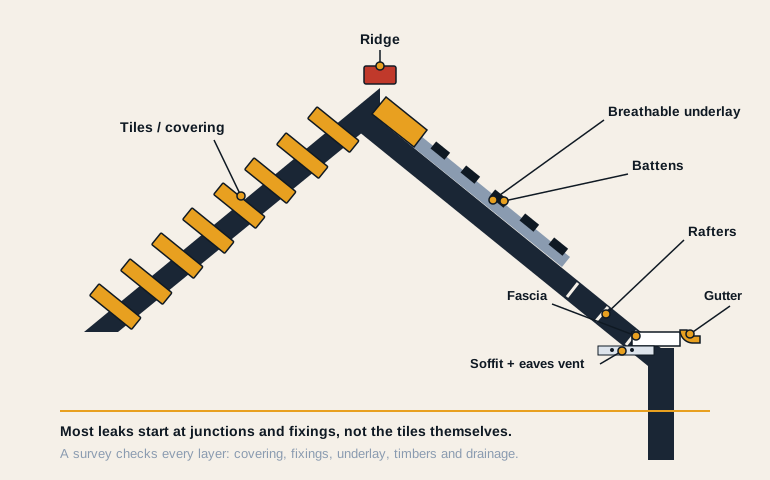
The most important principle in Reading roof leak diagnosis is that the visible damp patch inside the property is rarely directly below the entry point. Water entering through a failed flashing, a cracked tile, or a blocked valley travels along rafters, across felt, and down wall faces before dripping onto a ceiling. A damp patch on a bedroom ceiling directly below the ridge may trace to a lead flashing failure at the chimney 3 metres away. Following the water path from the visible symptom back to the source requires physical inspection at roof level.
The three most common sources of roof leaks on Reading properties, in our experience across 20 years and all Reading postcodes: lead flashing failure at chimney stacks and abutments — particularly on the Victorian and Edwardian stock of Newtown, Katesgrove and Caversham; nail sickness on 1960s-70s concrete tile estates in Whitley, Southcote and the older Woodley sections allowing tiles to lift and admit water during rain; and blocked valleys causing water to back up under the tile course — accelerated by Reading's above-average leaf fall.
We carry the most common Reading tile profiles on our vehicles at all times, along with code 4 and code 5 lead sheet, EPDM patch material for flat roof emergencies, and valley lining material. For the majority of leak sources we identify on a first visit in Reading, we can complete the repair on the same day without returning for materials.
Honest advice
Do You Actually Need Roof Repairs?
Most Reading roof problems announce themselves indoors first — a stain, a drip, a patch of damp — long before the cause is visible from the ground. The trick is tracing the symptom back to the actual fault.
A damp patch or brown stain on an upstairs ceiling after rain
A slipped, cracked or missing tile visible from the ground
Water tracking down a chimney breast or around a rooflight
Debris (mortar, tile fragments) in the gutters or on the drive
Daylight visible through the roof from inside the loft
When it is not the answer: If more than about a third of the covering has failed — widespread nail sickness on a 1960s-70s Whitley or Southcote estate roof, for instance — repairing tile-by-tile is money wasted. Read the full guide.
We inspect from roof level, lift sample tiles to check the fixings and underlay, and trace the leak to its real source — not the nearest visible symptom.
2. Written itemised quote
You get a fixed, written price naming the fault, the fix and the guarantee — no lump-sum guesswork.
3. Scheduling
We agree a date; for common faults we carry matching materials to fix on the first visit.
4. The repair
We carry out the work, document any hidden damage found with photos, and make the roof weathertight.
5. Cleanup & sign-off
We clear debris, leave the site tidy, and hand over the written workmanship guarantee.
Timescales
Typical Timescales
Job
Typical duration
Slipped or cracked tile refix
1-2 hours
Lead flashing repair
Half a day
Section of nail-sick tiles refixed
Half to full day
Rear valley rebuild
1-2 days
Chimney flashing renewal
1 day
Wet or high-wind days pause tiling and lead work — we build weather margin into every booking and never leave a roof open overnight.
Access
Access, Scaffolding & Permits in Reading
Most Reading repairs run from roof ladders or a tower; scaffold is quoted only where the job needs safe standing time at height. Scaffold is specified for: chimney-side repairs, full valley rebuilds, ridge work on exposed Tilehurst and Caversham Heights streets, or anything beyond a day at height - always itemised in your written quote, never a hidden extra, and we arrange it.
Reading's mix of Victorian terraces in Newtown and Katesgrove and post-war estate housing in Whitley and Lower Earley means access varies from tight terraced frontages to open estate driveways. Pavement scaffold and skip permits go through Reading Borough Council; allow a few working days on streets like Newtown terraces off the Oxford Road, the narrow streets of Katesgrove where space is tight.
Pricing
What Roof Repairs Costs in Reading
Job
Typical range
Notes
Slipped or cracked tile refix
£150-£300
Per visit incl. access
Lead flashing repair / renewal
£280-£800
Chimney or abutment
Section of nail-sick tiles refixed
£300-£600
Signals wider issue
Valley renewal
£400-£1,200
Depending on length
Ridge repointing (per run)
£300-£1,000
Exposed stock weathers faster
Emergency make-safe call-out
£150-£450
Same-day, stated up front
What moves the price
Roof height and access (bungalow vs three-storey terrace)
Whether the tile needs matching (clay in Newtown/Caversham costs more than concrete)
Scaffold vs tower vs ladder for the specific fault
How far the leak has tracked before it was caught
Hidden timber rot found once tiles are lifted
Worked example: A rear valley rebuild on a 1930s semi off the Wokingham Road, concrete tile, tower access: around £680 including access and waste removal.
No deposit on repairs under £500. Staged payments on larger jobs — nothing up front before materials are on site. All prices include VAT.
Guarantee
What the 10-Year Guarantee Actually Covers
Workmanship on the repaired section is covered for 10 years in writing; any replacement tiles and lead carry manufacturer warranties on top.
Covered: workmanship for 10 years, in writing, transferable if you sell.
On top: manufacturer warranties on materials (terms vary by product).
Not covered: storm or impact damage - that is an insurance matter, and we will document it for your claim.
If a fault appears in covered work, we come back and put it right. No quibbling, no re-charge.
A day of ladder or tower work and a small amount of tile debris — we sheet below the work area and clear everything before we leave. You do not need to stay home for external work - we just need power and access agreed in advance.
Repairs run year-round; temporary weatherproofing goes on the same day if rain stops work mid-job. Thames Valley humidity and the Kennet and Thames river corridors slow drying and accelerate moss, especially on north-facing slopes.
FAQ
Common Questions
Call us immediately on 0118 327 2383. While you wait: place buckets under active drips, move electronics and valuables away from affected areas, and turn off electrics on any circuit near water ingress. Do not attempt roof access. We provide same-day emergency response across all Reading postcodes for active leaks.
The cost depends entirely on the source. A blocked valley or failed flashing causing a leak typically costs £150 to £500 to fix. A failed flat roof section runs £300 to £800. Multiple tile failures causing widespread ingress can run to £500 to £1,200 for a thorough repair. We diagnose the actual source first — no guesswork — and quote before starting any work.
The most common hidden causes of leaks on Reading properties are: failed lead flashing at chimney stacks or abutments (often patched with mortar that has then cracked), a blocked valley collecting water that backs up under the tiles, felt underlay that has degraded to the point of letting water through even when tiles are intact, and nail sickness on 1960s–70s concrete tile roofs allowing tiles to lift in wind without visibly moving. Correct diagnosis requires getting onto the roof — a visual from the ground will not find any of these.
The entry point is rarely directly above the visible damp patch inside. Water travels along rafters and felt before dripping down. The most reliable approach is a systematic inspection from roof level — starting at the ridge and working down — combined with a loft inspection tracing any staining or wet felt. We carry out leak diagnoses across Reading free of charge as part of any repair quote.
Yes, if left unaddressed. Water ingress into roof timbers causes wet rot in rafters and wall plates over months to years. Saturated insulation loses its thermal value and harbours mould. Repeated water penetration through ceilings causes plaster failure and eventually damages electrical systems. The cost of addressing a leak promptly is always a small fraction of the structural repair cost of ignoring it.
Sudden damage from a storm — a displaced tile causing immediate water ingress — is generally claimable. Gradual deterioration leading to a slow leak is typically not covered and is considered the homeowner's maintenance responsibility. The distinction matters: if a storm event directly caused your leak, document it and contact your insurer promptly. We provide written reports for insurance purposes.
For active leaks we aim for same-day attendance anywhere in Reading to make the building safe. Most straightforward repairs — a failed flashing, a blocked valley, a section of displaced tiles — are completed the same day or the following morning. More complex repairs are scoped on the first visit and booked for the earliest available slot. We do not leave properties unsecured between visits.
Get In Touch
Roof Leaking? Call Now.
Same-day response across Reading and Berkshire. We find the source and fix it.