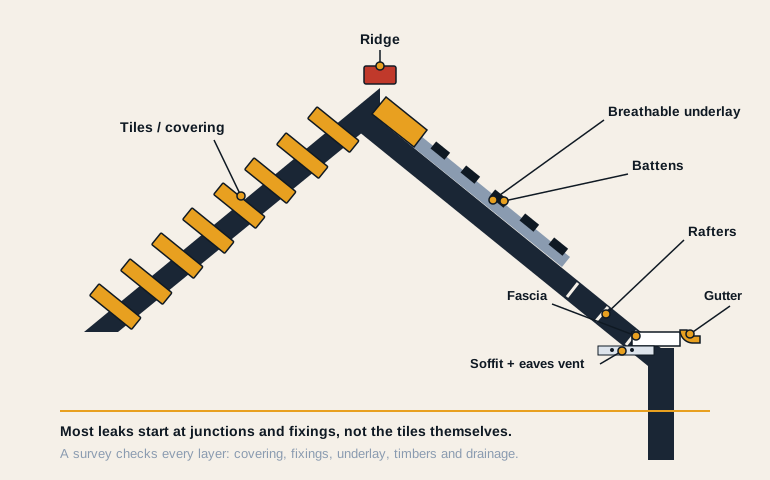
Earley and Lower Earley's large 1970s–90s housing stock is entering its first major maintenance cycle. Ridge mortar failures, aging underlays and flat extension roof deterioration are the three most common repair categories across RG6.
Lower Earley is one of the largest single-phase residential developments in the UK, built primarily between 1975 and 1990. The estate's housing stock is now 35–50 years old — the age bracket at which the first significant roofing maintenance occurs. The most common repair categories we handle across Lower Earley are ridge mortar failures, aging felt underlays causing condensation and occasional slow seepage, and flat roof failures on rear kitchen extensions built as part of the original construction.
Mortar ridge failures across Lower Earley's estate stock follow a predictable pattern at this age. The original sand-and-cement bed is carbonating, tiles are beginning to rock and in some cases have displaced. Re-bedding in flexible mortar compound extends the ridge life by 20+ years and avoids the water ingress risk of open joints at the roof apex.
Flat-roofed rear kitchen extensions — common across the Maiden Place and Hillside Road areas — are a growing source of repair calls as original felt and early rubber systems age. GRP replacement is our standard recommendation: a 25-year guaranteed system at a cost comparable to repeated felt repairs.
“Ridge mortar had been crumbling on our Lower Earley semi for years. Re-bedded and re-pointed in one day. Clean, efficient, exactly what was quoted.”
Claire B. · Lower Earley, RG6
★★★★★
“Flat kitchen extension roof leaking after heavy rain. GRP replacement installed in a day. Professional throughout and they left the garden spotless.”
Nicola H. · Maiden Erlegh, Earley RG6
★★★★★
“Pre-purchase survey on a Lower Earley property. Thorough report — identified ridge issues and an aging underlay. Used it to negotiate. Worth every penny.”
Andrew P. · Lower Earley, RG6
Honest advice
Do You Actually Need Roof Repairs?
Most Reading roof problems announce themselves indoors first — a stain, a drip, a patch of damp — long before the cause is visible from the ground. The trick is tracing the symptom back to the actual fault.
A damp patch or brown stain on an upstairs ceiling after rain
A slipped, cracked or missing tile visible from the ground
Water tracking down a chimney breast or around a rooflight
Debris (mortar, tile fragments) in the gutters or on the drive
Daylight visible through the roof from inside the loft
When it is not the answer: If more than about a third of the covering has failed — widespread nail sickness on a 1960s-70s Whitley or Southcote estate roof, for instance — repairing tile-by-tile is money wasted. Read the full guide.
We inspect from roof level, lift sample tiles to check the fixings and underlay, and trace the leak to its real source — not the nearest visible symptom.
2. Written itemised quote
You get a fixed, written price naming the fault, the fix and the guarantee — no lump-sum guesswork.
3. Scheduling
We agree a date; for common faults we carry matching materials to fix on the first visit.
4. The repair
We carry out the work, document any hidden damage found with photos, and make the roof weathertight.
5. Cleanup & sign-off
We clear debris, leave the site tidy, and hand over the written workmanship guarantee.
Timescales
Typical Timescales
Job
Typical duration
Slipped or cracked tile refix
1-2 hours
Lead flashing repair
Half a day
Section of nail-sick tiles refixed
Half to full day
Rear valley rebuild
1-2 days
Chimney flashing renewal
1 day
Wet or high-wind days pause tiling and lead work — we build weather margin into every booking and never leave a roof open overnight.
Access
Access, Scaffolding & Permits in Earley
Most Reading repairs run from roof ladders or a tower; scaffold is quoted only where the job needs safe standing time at height. Scaffold is specified for: chimney-side repairs, full valley rebuilds, ridge work on exposed Tilehurst and Caversham Heights streets, or anything beyond a day at height - always itemised in your written quote, never a hidden extra, and we arrange it.
Earley and Lower Earley are 1975-90 concrete-tile estates on open plots — good driveway access, with wind funnelling between the estate roads on exposed corners. Pavement scaffold and skip permits go through Wokingham Borough Council; allow a few working days on streets like the closes around Lower Earley where space is tight.
Pricing
What Roof Repairs Costs in Reading
Job
Typical range
Notes
Slipped or cracked tile refix
£150-£300
Per visit incl. access
Lead flashing repair / renewal
£280-£800
Chimney or abutment
Section of nail-sick tiles refixed
£300-£600
Signals wider issue
Valley renewal
£400-£1,200
Depending on length
Ridge repointing (per run)
£300-£1,000
Exposed stock weathers faster
Emergency make-safe call-out
£150-£450
Same-day, stated up front
What moves the price
Roof height and access (bungalow vs three-storey terrace)
Whether the tile needs matching (clay in Newtown/Caversham costs more than concrete)
Scaffold vs tower vs ladder for the specific fault
How far the leak has tracked before it was caught
Hidden timber rot found once tiles are lifted
Worked example: A rear valley rebuild on a 1930s semi off the Wokingham Road, concrete tile, tower access: around £680 including access and waste removal.
No deposit on repairs under £500. Staged payments on larger jobs — nothing up front before materials are on site. All prices include VAT.
Guarantee
What the 10-Year Guarantee Actually Covers
Workmanship on the repaired section is covered for 10 years in writing; any replacement tiles and lead carry manufacturer warranties on top.
Covered: workmanship for 10 years, in writing, transferable if you sell.
On top: manufacturer warranties on materials (terms vary by product).
Not covered: storm or impact damage - that is an insurance matter, and we will document it for your claim.
If a fault appears in covered work, we come back and put it right. No quibbling, no re-charge.
Covering RG6 and surrounding postcodes.
Good to know
What It Is Like While We Work
A day of ladder or tower work and a small amount of tile debris — we sheet below the work area and clear everything before we leave. You do not need to stay home for external work - we just need power and access agreed in advance.
Repairs run year-round; temporary weatherproofing goes on the same day if rain stops work mid-job. Open, slightly exposed estate ground where wind lifts nail-sick and loose verge tiles.
FAQ
Common Questions
If your property was built between 1975 and 1990 and hasn't had a roof inspection in the last five years, it's worth booking one. Ridge mortar, tile fixing and felt underlays from this era are now 35–50 years old and showing age-related failures across Lower Earley. Early attention is cheaper than waiting for a leak.
Ridge repointing on a standard Earley semi costs £300–£600. Individual tile re-bedding costs £150–£280. We provide free quotes.
Yes. Flat extension roof repair and GRP replacement is one of the most common jobs we carry out across Lower Earley and Earley. Most original felt systems from this era are at or past end of life. GRP replacement costs £1,400–£2,200 for a typical extension and carries a 25-year guarantee.
Yes — all of Earley including Lower Earley, Maiden Erlegh, the Wokingham Road corridor and across to the Shinfield Road boundary. Call 0118 327 2383 for a free survey.
Yes. Lower Earley's estate housing from 1975 to 1990 is showing the first signs of nail fatigue on the older end of its range. We carry out nail sickness assessments across Earley regularly. Where fewer than 20% of tiles are affected, selective renailing is cost-effective. Where failure is more widespread, re-roofing is the better investment.
Contact your housing association in the first instance. For privately owned properties, or where the housing association is not responding adequately to an urgent problem, we can assess and repair directly. We provide written reports that tenants can use to support maintenance requests.
Minor tile repairs in Earley typically run £150 to £350. More involved repairs — valley work, ridge repointing, flashing replacement — range from £350 to £800. We provide itemised written quotes before starting any work.
Why Earley Specifically
Roof Repairs in Earley — Local Conditions
Earley and Lower Earley occupy gently undulating ground south of the A329, at 45 to 65 metres above sea level. The position is broadly sheltered with no exceptional weather exposure. Humidity is moderate — slightly higher than the Tilehurst ridge but lower than the Thames riverfront. The key climate factor for Earley roofing is the combination of mild temperatures and periodic heavy rainfall typical of the Thames Valley, which accelerates biological growth on north-facing roof slopes.
The Earley housing stock is split between the older village properties around St Peter's Church — Victorian and Edwardian on clay tile — and the vast Lower Earley estate developed from 1975 to 1990. Lower Earley is the largest single residential development in the Reading area and its concrete interlocking tile stock is now 35 to 50 years old. The estate was built with iron nails, and the oldest sections — those completed before 1980 — are at high nail fatigue risk. Flat-roofed integral garages feature on the majority of Lower Earley properties.
For roof repairs work in Earley, this translates directly into how we approach the job. Lower Earley generates the highest volume of nail sickness survey requests of any single area in the Reading catchment. The concentration of 1975–1990 concrete tile on original iron nails across thousands of adjacent properties means the maintenance need is reaching a critical threshold simultaneously. Flat roof failures on original-build garages are the second most common call type. These are not issues we encounter occasionally — they are the characteristic call types from the RG6 postcode and our teams have the materials and experience to address them correctly on the first visit.
Spring and early summer is peak survey season for Earley — tiles displaced during the winter storm season become visible once scaffolding goes up on neighbouring properties, driving a cluster effect of surveys and re-roofs through April to July. Knowing this seasonal pattern means we can give you a realistic timeline for booking work in Earley — and advise you if your situation warrants treating the job as more urgent.
Free survey in Earley RG6 — call 0118 327 2383 to arrange. No call-out fee, written quote before any work starts.
How We Approach Roof Repairs
Every roof repair we carry out begins with a physical inspection from roof level — not a visual assessment from the ground. We lift sample tiles to check nail and batten condition, probe mortar for hidden deterioration, and physically test lead flashings for movement. This takes longer than a pavement-level quote but it means the repair addresses the actual cause rather than the visible symptom.
We provide a written, itemised quote before any work starts. The quote specifies what will be done, what materials will be used by name and grade, and what the workmanship guarantee covers. We do not begin work until you have accepted the quote in writing. There are no verbal agreements on price that can be reinterpreted later.
For repairs on occupied properties, we confirm the programme the morning of the work and leave the property weathertight each day before we depart. If a repair identifies additional underlying issues — degraded felt underlay visible once tiles are lifted, rotten batten sections — we photograph the finding and discuss options before proceeding. No hidden extras.
Materials and Specification
Material matching is the most important technical decision on any roof repair. Replacing a clay plain tile with a concrete interlocking tile — or the wrong clay profile — creates drainage problems at the junction and is visually obvious from the street. We hold matching stock for the most common Reading tile profiles and source less common profiles from specialist suppliers within 24 to 48 hours.
For mortar-bedded elements — ridge tiles, verge details, chimney haunching — we use a flexible polymer-modified mortar on post-1950 properties, and lime-based mortar on pre-1940 properties where the original brickwork requires it. Using cement-based mortar on lime-bonded Victorian brickwork causes spalling; this is one of the most common causes of deterioration we find on Newtown and Katesgrove terraces that have been previously worked on by contractors unfamiliar with period materials.
Get In Touch
Free Quote — No Obligation
No call-out fees. A straight answer from a local roofer who knows Earley.