Whitley's large post-war and 1960s estates generate more roofing demand than almost anywhere else in Reading. We know the concrete tile stock, the nail sickness patterns and the flat roof failures that are common across RG2.
Whitley is one of Reading's most densely populated residential areas, developed primarily from the 1950s through the 1970s with large local authority and private estate housing. The dominant housing type — and the dominant source of roofing calls — is the concrete interlocking tile semi-detached and terraced house. Many of these roofs are now 45–60 years old, having been built between 1958 and 1978, and are showing the failure modes characteristic of that generation of concrete tile roof.
The primary issue across Whitley is nail sickness: the original iron cut nails used to fix concrete interlocking tiles have corroded after decades of wet winters. Affected tiles are held only by their own weight and contact with neighbouring tiles — a condition that becomes dangerous in high winds. The Whitley estate's relatively low-lying position provides some shelter from the south-west, but nail-sick tiles still displace during storm events with increasing frequency as corrosion advances.
Common Roofing Problems in Whitley
Nail sickness across 1960s–70s concrete interlocking tile roofs throughout the estate. Mortar ridge failures — the same age as the tile fixing and failing on a similar timeline. Flat-roofed garages, common on Whitley's terrace properties, reaching end of felt or early rubber system life. Blocked gutters in autumn due to leaf fall from the mature limes and planes along the estate roads.
“Nail sickness on our 1970s terrace in Whitley — they were straight about the extent of it. Didn't try to push us into a full re-roof when targeted repairs could extend the roof by another 10 years. Honest, competent and priced fairly.”
Tony M. · Whitley, Reading RG2
★★★★★
“Flat garage roof had been leaking since we bought the house. Reading Roofing stripped it and put a GRP system on. One day's work, clean finish, no more leaks. Should have done it sooner.”
Sharon W. · Whitley, Reading RG2
★★★★★
“Emergency call after tiles came off in the October storms. They came the next morning, replaced the affected tiles and checked the whole rear slope while they were up. Fair price and no drama.”
Whitley presents the most concentrated nail sickness risk of any single area in the Reading catchment. The density of 1958-1972 concrete interlocking tile on original iron nails, across thousands of adjacent properties, means the maintenance need is not a collection of individual problems — it is a population-level issue reaching a threshold simultaneously.
The economic logic of proactive replacement in Whitley is clear: a planned re-roof on an agreed programme with scaffold shared between properties costs less per property than emergency re-roofing under storm conditions, with premium charges, rushed programmes and limited material availability. For homeowners on the oldest Whitley streets, the question is no longer whether the roof needs replacing but when.
Free nail sickness survey in Whitley RG2 — call 0118 327 2383.
Honest advice
Do You Actually Need Roof Repairs?
Most Reading roof problems announce themselves indoors first — a stain, a drip, a patch of damp — long before the cause is visible from the ground. The trick is tracing the symptom back to the actual fault.
A damp patch or brown stain on an upstairs ceiling after rain
A slipped, cracked or missing tile visible from the ground
Water tracking down a chimney breast or around a rooflight
Debris (mortar, tile fragments) in the gutters or on the drive
Daylight visible through the roof from inside the loft
When it is not the answer: If more than about a third of the covering has failed — widespread nail sickness on a 1960s-70s Whitley or Southcote estate roof, for instance — repairing tile-by-tile is money wasted. Read the full guide.
We inspect from roof level, lift sample tiles to check the fixings and underlay, and trace the leak to its real source — not the nearest visible symptom.
2. Written itemised quote
You get a fixed, written price naming the fault, the fix and the guarantee — no lump-sum guesswork.
3. Scheduling
We agree a date; for common faults we carry matching materials to fix on the first visit.
4. The repair
We carry out the work, document any hidden damage found with photos, and make the roof weathertight.
5. Cleanup & sign-off
We clear debris, leave the site tidy, and hand over the written workmanship guarantee.
Timescales
Typical Timescales
Job
Typical duration
Slipped or cracked tile refix
1-2 hours
Lead flashing repair
Half a day
Section of nail-sick tiles refixed
Half to full day
Rear valley rebuild
1-2 days
Chimney flashing renewal
1 day
Wet or high-wind days pause tiling and lead work — we build weather margin into every booking and never leave a roof open overnight.
Access
Access, Scaffolding & Permits in Whitley
Most Reading repairs run from roof ladders or a tower; scaffold is quoted only where the job needs safe standing time at height. Scaffold is specified for: chimney-side repairs, full valley rebuilds, ridge work on exposed Tilehurst and Caversham Heights streets, or anything beyond a day at height - always itemised in your written quote, never a hidden extra, and we arrange it.
Whitley is dominated by 1958-72 concrete-tile estate housing — straightforward driveway access, and the epicentre of nail sickness in the borough. Pavement scaffold and skip permits go through Reading Borough Council; allow a few working days on streets like the estate roads across Whitley where space is tight.
Pricing
What Roof Repairs Costs in Reading
Job
Typical range
Notes
Slipped or cracked tile refix
£150-£300
Per visit incl. access
Lead flashing repair / renewal
£280-£800
Chimney or abutment
Section of nail-sick tiles refixed
£300-£600
Signals wider issue
Valley renewal
£400-£1,200
Depending on length
Ridge repointing (per run)
£300-£1,000
Exposed stock weathers faster
Emergency make-safe call-out
£150-£450
Same-day, stated up front
What moves the price
Roof height and access (bungalow vs three-storey terrace)
Whether the tile needs matching (clay in Newtown/Caversham costs more than concrete)
Scaffold vs tower vs ladder for the specific fault
How far the leak has tracked before it was caught
Hidden timber rot found once tiles are lifted
Worked example: A rear valley rebuild on a 1930s semi off the Wokingham Road, concrete tile, tower access: around £680 including access and waste removal.
No deposit on repairs under £500. Staged payments on larger jobs — nothing up front before materials are on site. All prices include VAT.
Guarantee
What the 10-Year Guarantee Actually Covers
Workmanship on the repaired section is covered for 10 years in writing; any replacement tiles and lead carry manufacturer warranties on top.
Covered: workmanship for 10 years, in writing, transferable if you sell.
On top: manufacturer warranties on materials (terms vary by product).
Not covered: storm or impact damage - that is an insurance matter, and we will document it for your claim.
If a fault appears in covered work, we come back and put it right. No quibbling, no re-charge.
Covering RG2 and surrounding postcodes.
Good to know
What It Is Like While We Work
A day of ladder or tower work and a small amount of tile debris — we sheet below the work area and clear everything before we leave. You do not need to stay home for external work - we just need power and access agreed in advance.
Repairs run year-round; temporary weatherproofing goes on the same day if rain stops work mid-job. South Reading estate ground; the 1958-72 concrete tile here is the classic nail-sickness stock.
FAQ
Roofing Questions for Whitley
Yes — nail sickness is the most common roofing issue we diagnose across Whitley's 1960s–70s housing stock. The original iron cut nails used on this generation of concrete tile roofs corrode over 40–60 years. If your property was built between 1958 and 1978 and hasn't had a roof survey, it's worth having us inspect the nail fixing condition.
Targeted tile replacement and minor repairs typically cost £150–£350 in Whitley. Ridge repointing on a standard terrace runs £300–£550. Full re-roofing on a 3-bed terraced house costs £5,000–£7,500 depending on size and access. Free quotes provided.
Yes — Whitley is within our core Reading coverage area. For genuine emergencies involving active leaks or displaced tiles after storm events, we aim to attend the same day. Call 0118 327 2383 for a same-day response.
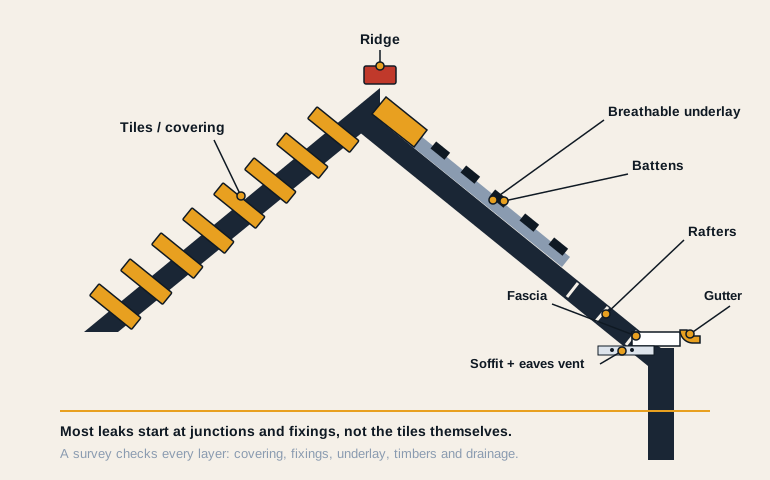
Yes — this is exactly the assessment we carry out on survey. We inspect tile condition, nail fixing, ridge mortar, batten and underlay where accessible, and give you an honest recommendation. For many Whitley properties, targeted repairs can extend the roof's life by 10+ years at a fraction of replacement cost. We'll tell you which applies.
Whitley was built predominantly between 1958 and 1972. Nail sickness on the original iron-nailed concrete interlocking tile stock — now 50 to 65 years old — is widespread. Flat-roofed garages on original felt are at or beyond end of life. Lead flashings on chimney stacks have been repeatedly patched with mortar rather than replaced correctly.
Yes. We carry out full re-roofs across Whitley and the surrounding RG2 postcodes. The 1960s and 70s concrete tile stock is replaced like-for-like with modern Marley or Redland concrete tiles on new battens and BS 5534 underlay.
Reading Borough Council has run improvement grant schemes for older housing stock in areas including Whitley. Eligibility depends on property ownership and income criteria. We recommend checking directly with Reading Borough Council's housing improvement team. We can provide written cost assessments to support grant applications.
Whitley occupies gently sloping ground south of Reading town centre, at 35 to 55 metres above sea level. The position is broadly sheltered compared to the exposed ridge suburbs, but the M4 motorway embankment to the south creates some wind channelling. The main climate factor is the moderate Thames Valley humidity which sustains biological growth on north-facing roof slopes across the estate stock. Whitley's proximity to Coley Park woodland to the west also contributes to autumn debris loading.
Whitley is one of Reading's primary post-war housing estates, developed predominantly between 1958 and 1972. The housing stock is almost entirely concrete interlocking tile — Marley and Redland profiles on original iron nails, now 50 to 65 years old. This is the oldest nail-sickness-risk stock in the Reading catchment. The estate also contains a significant proportion of flat-roofed sections — maisonette blocks and attached garages — many still on original 1960s–70s built-up felt. Victorian terraces exist on the northern Whitley streets bordering Katesgrove.
Nail sickness is the defining roofing issue in Whitley. Properties from the early estate phases — pre-1965 — are at highest risk, with iron nails now 60+ years old. We identify advanced nail corrosion on virtually every roof survey we conduct on Whitley's oldest streets. Flat roof felt failure on estate maisonettes and garages is the second most common issue. The combination of age and density means Whitley generates proportionally more re-roof work per square kilometre than any other Reading area.
Emergency call-outs in Whitley are concentrated in the storm season — October through February — as nail-sick tiles already on the point of failure become displaced in wind. Pre-emptive survey season runs April to August as homeowners prepare before winter. Understanding this pattern means we can give homeowners in Whitley honest timing advice and help prioritise maintenance work before peak demand periods.
Free survey in Whitley RG2 with no call-out fee — call 0118 327 2383.