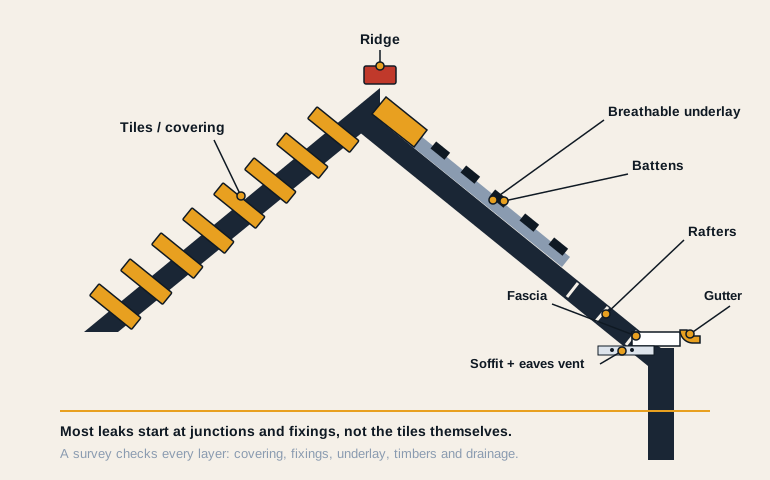
Newtown's dense Victorian and Edwardian terraces require a roofer who understands original clay plain tiles, Welsh slate, period chimney stacks and conservation area material requirements. We work on this stock every week.
Newtown is one of Reading's Victorian suburbs — a dense grid of terraced houses built primarily between 1870 and 1910 to house the workers of the town's expanding industries. Waylen Street, Minster Street, Cardiff Road and the roads of the Morgan Road grid are characterised by two-storey bay-fronted terraces with clay plain tile roofs and ornate chimney stacks. Most of these properties retain original or period-appropriate clay tiles and Welsh slate on dormers and bay roofs.
The nature of terrace housing creates specific roofing challenges. Party chimney stacks are shared between two properties — repairs require coordination and both halves of the stack should be inspected simultaneously. The density of the street pattern means scaffolding access is often constrained, requiring careful planning. Conservation area guidance applies to visible street-facing elevations, requiring like-for-like material replacement on the front roof slope.
Common Roofing Problems in Newtown
Lead flashing failure on chimney stacks — particularly front apron and step flashings on south-facing chimney abutments where thermal cycling is greatest. Clay plain tile sourcing for front slope repairs where original stock has broken or slipped. Party chimney stack deterioration — shared stacks where only one half has received recent attention. Valley lead fatigue on rear additions and bay roofs.
“Victorian terrace on Cardiff Road — three clay tiles had cracked on the front slope, directly visible from the street. Reading Roofing sourced secondhand tiles that matched the weathering of the originals almost perfectly. Clean job, exactly right result.”
Patricia L. · Cardiff Road, Newtown RG1
★★★★★
“Party chimney stack was causing damp on our landing. Lead apron had failed and been pointed over twice previously. Reading Roofing stripped it back, new lead dressed correctly, pointed over the top. Dry since.”
Marcus H. · Waylen Street, Newtown RG1
★★★★★
“Pre-purchase survey on a Newtown terrace. The report identified a failed valley, a cracked tile on the rear slope and a chimney stack that needed repointing — none of which appeared in the homebuyer's survey. We used it to negotiate a reduction. Very useful.”
Newtown is Reading's most demanding roofing area in terms of specialist knowledge requirements. The combination of conservation area designation, shared chimney stacks, 100-120-year-old clay tile, lime-bonded brickwork, and complex Victorian rear roofline arrangements means that most jobs here require specialist assessment rather than standard trade practices.
We have worked in Newtown since 2003. We know the conservation area boundaries, the standard clay tile profiles for the area, the lime mortar specifications for the most common brick types, and the practical logistics of working on narrow terrace streets with tight scaffold access. A survey for a Newtown property includes an automatic conservation area check and written advice on any material requirements before we quote.
Most Reading roof problems announce themselves indoors first — a stain, a drip, a patch of damp — long before the cause is visible from the ground. The trick is tracing the symptom back to the actual fault.
A damp patch or brown stain on an upstairs ceiling after rain
A slipped, cracked or missing tile visible from the ground
Water tracking down a chimney breast or around a rooflight
Debris (mortar, tile fragments) in the gutters or on the drive
Daylight visible through the roof from inside the loft
When it is not the answer: If more than about a third of the covering has failed — widespread nail sickness on a 1960s-70s Whitley or Southcote estate roof, for instance — repairing tile-by-tile is money wasted. Read the full guide.
We inspect from roof level, lift sample tiles to check the fixings and underlay, and trace the leak to its real source — not the nearest visible symptom.
2. Written itemised quote
You get a fixed, written price naming the fault, the fix and the guarantee — no lump-sum guesswork.
3. Scheduling
We agree a date; for common faults we carry matching materials to fix on the first visit.
4. The repair
We carry out the work, document any hidden damage found with photos, and make the roof weathertight.
5. Cleanup & sign-off
We clear debris, leave the site tidy, and hand over the written workmanship guarantee.
Timescales
Typical Timescales
Job
Typical duration
Slipped or cracked tile refix
1-2 hours
Lead flashing repair
Half a day
Section of nail-sick tiles refixed
Half to full day
Rear valley rebuild
1-2 days
Chimney flashing renewal
1 day
Wet or high-wind days pause tiling and lead work — we build weather margin into every booking and never leave a roof open overnight.
Access
Access, Scaffolding & Permits in Newtown
Most Reading repairs run from roof ladders or a tower; scaffold is quoted only where the job needs safe standing time at height. Scaffold is specified for: chimney-side repairs, full valley rebuilds, ridge work on exposed Tilehurst and Caversham Heights streets, or anything beyond a day at height - always itemised in your written quote, never a hidden extra, and we arrange it.
Newtown is dense Victorian terracing near the town centre — tight frontages, shared party walls and chimney stacks, and pavement scaffold that often needs a permit. Pavement scaffold and skip permits go through Reading Borough Council; allow a few working days on streets like the tight terraced streets of Newtown, roads off the Oxford Road where space is tight.
Pricing
What Roof Repairs Costs in Reading
Job
Typical range
Notes
Slipped or cracked tile refix
£150-£300
Per visit incl. access
Lead flashing repair / renewal
£280-£800
Chimney or abutment
Section of nail-sick tiles refixed
£300-£600
Signals wider issue
Valley renewal
£400-£1,200
Depending on length
Ridge repointing (per run)
£300-£1,000
Exposed stock weathers faster
Emergency make-safe call-out
£150-£450
Same-day, stated up front
What moves the price
Roof height and access (bungalow vs three-storey terrace)
Whether the tile needs matching (clay in Newtown/Caversham costs more than concrete)
Scaffold vs tower vs ladder for the specific fault
How far the leak has tracked before it was caught
Hidden timber rot found once tiles are lifted
Worked example: A rear valley rebuild on a 1930s semi off the Wokingham Road, concrete tile, tower access: around £680 including access and waste removal.
No deposit on repairs under £500. Staged payments on larger jobs — nothing up front before materials are on site. All prices include VAT.
Guarantee
What the 10-Year Guarantee Actually Covers
Workmanship on the repaired section is covered for 10 years in writing; any replacement tiles and lead carry manufacturer warranties on top.
Covered: workmanship for 10 years, in writing, transferable if you sell.
On top: manufacturer warranties on materials (terms vary by product).
Not covered: storm or impact damage - that is an insurance matter, and we will document it for your claim.
If a fault appears in covered work, we come back and put it right. No quibbling, no re-charge.
Covering RG1 and surrounding postcodes.
Good to know
What It Is Like While We Work
A day of ladder or tower work and a small amount of tile debris — we sheet below the work area and clear everything before we leave. You do not need to stay home for external work - we just need power and access agreed in advance.
Repairs run year-round; temporary weatherproofing goes on the same day if rain stops work mid-job. Low-lying and close to the Kennet, Newtown terraces see town-centre humidity and shared-stack flashing leaks.
FAQ
Roofing Questions for Newtown
Yes — Victorian terraced properties in Newtown make up a significant part of our Reading workload. We understand clay plain tile profiles, sourcing of secondhand tiles for like-for-like matching, period chimney flashing details and the conservation area guidance that applies to visible street-facing elevations in this part of Reading.
In most cases, yes. We work with specialist reclaim tile suppliers holding significant stocks of weathered clay plain tiles. For front-elevation repairs where visual match matters, we source reclaim first. Perfect colour matching can't be guaranteed — clay tiles weather differently — but a close match on profile and general appearance is usually achievable.
Yes. Shared chimney stacks on semi-detached and terraced properties require both halves to be inspected when one shows failure. Water often tracks from the neglected half into the maintained half. We recommend inspecting the full stack when called to one side.
Chimney apron replacement typically costs £200–£380 in Newtown. Full chimney flashing replacement (step flashing, apron, back gutter and soakers) runs £420–£700. Free quotes with no call-out fee.
Newtown's Victorian terraces present: clay plain tile roofs with original iron nail fixings now over 100 years old, shared party chimney stacks that have often been repaired incompatibly by different roofers, lead valleys that may have been replaced with mortar patches, and conservation area obligations in parts of the area requiring material matching.
Parts of Newtown fall within Reading's conservation area designations. For like-for-like tile replacement using identical materials, consent is generally not required. For material changes such as replacing clay with concrete, consent may be needed. We check the conservation area status for your specific address and advise before materials are ordered.
A party chimney stack sits on the party wall between two terraced properties and serves both houses. Both owners share responsibility for the structural elements of the stack. We are experienced in coordinating repairs across both properties when shared stack work is required.
Newtown occupies the inner urban core of Reading, at 40 to 55 metres above sea level. The urban heat island effect moderates temperatures slightly compared to outlying suburbs, but the density of the Victorian terrace stock means properties are closely coupled — lead and tile failures on party chimney stacks affect multiple homeowners simultaneously. Newtown's position in the central Reading bowl gives reasonable shelter from the south-westerly prevailing wind.
Newtown is Reading's most intact Victorian residential district. The streets north and south of the Oxford Road — Argyle Street, Waylen Street, Zinzan Street and the surrounding grid — were built predominantly between 1875 and 1905. The stock is almost entirely clay plain tile, with some early Welsh slate on higher-specification Edwardian properties. Party chimney stacks are shared between adjacent terraces, creating maintenance interdependencies that complicate repair logistics. Parts of Newtown fall within Reading's conservation area designation requiring clay tile for replacements.
Lead flashing failure on party chimney stacks is the defining repair type in Newtown — the dense terrace stock means chimney stacks are numerous and complex. Clay plain tile nail fatigue on 100-to-120-year-old stock is the second major issue. Repointing requirements for original lime mortar on period brickwork require specialist knowledge. Valley failure from blocked guttering on complex rear roofline arrangements of Victorian back additions is a consistent call type.
Newtown has relatively even demand through the year given the age of the stock and the prevalence of chimney-related issues which are not strongly seasonal. Autumn brings valley blockages. Spring brings post-winter survey requests. Lead flashing failures tend to present in spring after freeze-thaw cycles. Understanding this pattern means we can give homeowners in Newtown honest timing advice and help prioritise maintenance work before peak demand periods.
Free survey in Newtown RG1 with no call-out fee — call 0118 327 2383.