Free roof surveys across Tilehurst and the surrounding RG31 area. Physical inspection from roof level, written report, itemised costs. Pre-purchase surveys also available.
A roof survey in Tilehurst means physical inspection from the roof surface — not a visual assessment from the ground. The 1930s semi-detached and pre-war housing stock across RG31 is elevated ridge position with high wind and weather exposure. The specific issues most commonly identified in this area require hands-on assessment: tile fixing integrity can only be confirmed by lifting sample tiles, flashing condition requires close inspection at the junction, and flat roof membrane condition requires walking the surface.
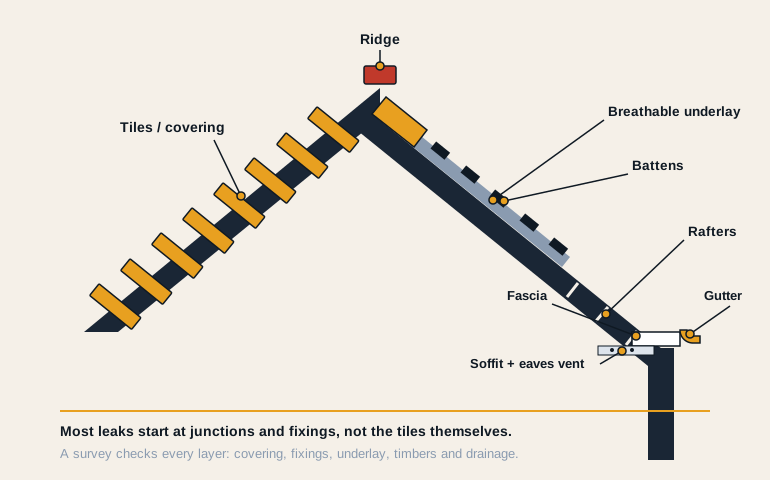
Our survey covers tile and fixing condition (sample tiles lifted to check nail integrity), ridge, hip and valley mortar or dry-fix condition, lead and EPDM flashing condition at all junctions, chimney stack pointing and pot security, flat roof membrane condition where applicable, and fascia, soffit and gutter condition. You receive a written report within 48 hours.
Pre-purchase surveys are formatted to be useful to solicitors and mortgage surveyors. If you are buying a property in Tilehurst and want an independent roof assessment before exchange, call us with the address and your expected exchange date and we will confirm a visit time.
“Pre-purchase survey before we exchanged. The report identified nail sickness on the rear slope that the HomeBuyer Report had missed. We renegotiated £4,500 off the price. The survey cost £180 and saved us thousands.”
Rachel P. · Norcot Road, Tilehurst RG31
★★★★★
“Free survey arranged after noticing some slipped tiles. Written report the next day, clear and specific. Gave us a proper plan for what needed doing and when. No pressure to proceed — just honest information.”
Robert C. · School Road, Tilehurst RG31
★★★★★
“Called to check the roof before letting our property. Thorough inspection, everything explained clearly in the written report. Two minor issues flagged that we had fixed before the tenants moved in. Exactly what we needed.”
Susan M. · Kentwood Hill, Tilehurst RG31
Honest advice
Do You Actually Need Roof Inspections?
A roof survey is worth it when you are buying a property, planning to sell, or unsure whether an ageing roof needs work — a written, roof-level assessment beats guessing from the ground or from a general homebuyer report.
You are buying a property and the homebuyer report flagged the roof
An ageing roof you are unsure about — repair, replace or leave
Recurring leaks you want diagnosed properly
Planning to sell and want to pre-empt buyer concerns
A specific defect you want assessed and costed
When it is not the answer: If you already know the fault and just want it fixed, you do not need a full survey first — book the repair. A survey is for when the decision itself is unclear. Read the full guide.
Call to arrange; we prioritise pre-purchase surveys with an approaching exchange date.
2. Roof-level inspection
We access the roof, lift sample tiles to check nail condition, flex flashings and test mortar — not a ground-level guess.
3. Written report
You get a written report within 48 hours with condition, priority ratings and itemised cost estimates.
4. Fee credited
If you book repair work with us, the inspection fee is credited in full against it.
Timescales
Typical Timescales
Job
Typical duration
Visual inspection + report
Half a day + 48h report
Drone inspection
1-2 hours + report
Pre-purchase survey
Half a day + 48h report
Full condition survey (large/listed)
1 day + report
We prioritise pre-purchase surveys with an exchange date; reports follow within 48 hours of the inspection.
Access
Access, Scaffolding & Permits in Tilehurst
Surveys use roof ladders, towers or a drone as the roof needs; physical roof-level access is what separates a real survey from a ground-level guess. Scaffold is specified for: large or complex roofs where safe standing access across the whole roof is needed - always itemised in your written quote, never a hidden extra, and we arrange it.
The Tilehurst ridge sits at 70-80m and takes the prevailing south-westerly directly; exposed gable and ridge access needs proper scaffold on the higher streets. Pavement scaffold and skip permits go through Reading Borough Council; allow a few working days on streets like Norcot Road, School Road where space is tight.
Pricing
What Roof Inspections Costs in Reading
Job
Typical range
Notes
Visual inspection + written report
£120-£250
Roof-level access
Drone roof inspection
£150-£350
Rapid whole-roof imagery
Pre-purchase / homebuyer survey
£200-£450
Documented for negotiation
Full condition survey (large/listed)
£300-£600
Detailed assessment
Fee credited against work booked
Yes
Full inspection fee
What moves the price
Roof size and complexity
Access requirements
Survey type (visual, drone, pre-purchase)
Report depth needed
Whether you book remedial work (fee credited)
Worked example: A pre-purchase survey on a Caversham semi that found nail sickness the homebuyer report missed: £280, and the buyer negotiated £4,000 off the price on the strength of the report.
Inspection fee credited in full against any repair or replacement work booked. All prices include VAT.
Guarantee
What the 10-Year Guarantee Actually Covers
The inspection fee is credited against any repair work booked; the report is an independent, honest assessment whether it finds problems or not.
Covered: workmanship for 10 years, in writing, transferable if you sell.
On top: manufacturer warranties on materials (terms vary by product).
Not covered: storm or impact damage - that is an insurance matter, and we will document it for your claim.
If a fault appears in covered work, we come back and put it right. No quibbling, no re-charge.
Covering RG30, RG31 and surrounding postcodes.
Good to know
What It Is Like While We Work
A survey is non-disruptive — a couple of hours of external access, no mess, no need to be home for external work. You do not need to stay home for external work - we just need power and access agreed in advance.
Surveys run year-round; drone inspection is weather-dependent (dry, low wind) but physical inspection runs in most conditions. Elevated and wind-exposed — the Tilehurst ridge weathers ridge mortar and chimney pointing faster than sheltered valley stock.
FAQ
Common Questions
Yes. Our standard roof survey across Tilehurst and the RG31 area is free of charge with no obligation to proceed. A pre-purchase survey with a formatted written report for solicitors costs £150 to £250 depending on property size.
Physical inspection of tile and fixing condition (lifting sample tiles to check nail integrity), ridge, hip and valley mortar or dry-fix condition, lead and EPDM flashing condition, chimney stack pointing and pot security, flat roof membrane condition where applicable, and fascia, soffit and gutter condition. Written report with photographs and itemised cost estimates delivered within 48 hours.
Yes, if the property has any risk factors — particularly 1930s semi-detached and pre-war construction. A HomeBuyer Report does not include physical inspection of tile fixings, ridge detail, or flashing condition from roof level. Our pre-purchase survey costs £150 to £250 and can identify problems before exchange that are difficult to negotiate once you have completed.
A standard 3-bed semi takes 45 to 90 minutes on site depending on roof complexity and the number of areas requiring detailed inspection. We spend time on the roof rather than rushing — a thorough survey from roof level is the only way to identify nail sickness, early flashing failure, and structural issues invisible from the ground.
Yes. All surveys result in a written report delivered within 48 hours of the visit. The report details every area inspected, condition found, any immediate concerns, advisory items for future attention, and itemised cost estimates for any recommended work. Pre-purchase surveys are formatted to be useful to solicitors and mortgage surveyors.
Yes. A written report from a qualified roofer identifying specific problems and estimated costs is exactly the kind of documented evidence estate agents and vendors take seriously in Tilehurst. It converts a vague concern into a concrete negotiating position with specific figures.
The most common findings on Tilehurst surveys are determined by the local housing stock. On 1930s semi-detached and pre-war properties, we most frequently identify: failed or mortar-patched lead flashings, ridge mortar at end of life, nail fatigue on concrete tile stock, and flat roof membranes on extensions or garages past their design life. We provide an honest assessment of each and what it is likely to cost to address.
Why Tilehurst Specifically
Roof Survey in Tilehurst — Local Conditions
Tilehurst occupies the elevated ridge west of Reading town centre, reaching 70 to 90 metres above sea level on the upper streets around Norcot Road, School Road and Kentwood Hill. This is one of the most exposed residential positions in the Reading catchment — south-westerly Atlantic weather arrives at Tilehurst before it reaches the valley floor, and wind speeds during storm events are consistently higher here than in central Reading. The elevated position also creates a frost pocket effect in winter, with the ridge streets experiencing more freeze-thaw cycles per year than low-lying Reading suburbs.
The dominant era in Tilehurst is 1920s to 1940s semi-detached, built during the inter-war expansion of Reading westward along the Bath Road corridor. These properties are on clay plain tile — original to the 1930s build, now 85 to 95 years old — with concrete plain tile on some post-war infill. The ridge position and the age of the stock create a specific vulnerability: mortar-bedded ridges on 1930s properties at the exposed ridge-top streets are typically 20 to 30 years past their last repointing requirement. Chimney stacks on these properties are large, shared-flue designs requiring specific access.
For roof survey work in Tilehurst, this translates directly into how we approach the job. Ridge mortar failure is the defining repair type in Tilehurst — the exposure at the ridge-top streets accelerates mortar weathering significantly compared to sheltered Reading suburbs. Clay plain tile nail fatigue on the oldest stock, chimney stack repointing and lead flashing renewal on prominent stacks, and post-storm emergency call-outs from the most exposed streets are the characteristic call types from this postcode. These are not issues we encounter occasionally — they are the characteristic call types from the RG31 postcode and our teams have the materials and experience to address them correctly on the first visit.
Autumn and winter are high-demand periods in Tilehurst — the exposed ridge position means storm-related call-outs (displaced ridge tiles, cracked mortar, lifted tiles) peak between October and February. Spring survey season follows as homeowners assess winter damage. Knowing this seasonal pattern means we can give you a realistic timeline for booking work in Tilehurst — and advise you if your situation warrants treating the job as more urgent.
Free survey in Tilehurst RG31 — call 0118 327 2383 to arrange. No call-out fee, written quote before any work starts.
Roof Surveys Across Reading
A roof survey in Reading is only useful if it is conducted from the roof surface, not from the ground or through binoculars. The findings that matter — nail condition on concrete tile, lead flashing integrity, felt underlay condition, batten spacing compliance — are invisible from ground level. A survey that claims to assess these from 8 metres below is not a survey; it is a guess.
Our survey process begins with a loft inspection where access is available — checking the underside of the deck for daylight penetration, felt condition, rafter and wall plate integrity, and any evidence of historic or active water ingress. We then access the roof from scaffold and work systematically from ridge to eaves: lifting sample tiles in sections to check nail condition and batten spacing, testing mortar on ridge and verge details, physically manipulating lead flashings to assess flexibility and adherence, and walking flat roof surfaces where present.
The written report covers every area inspected, condition found, priority classification of any issues (immediate action required, advisory for attention within 1–2 years, monitor), and an itemised cost estimate for all recommended work. The report is delivered within 48 hours of the survey visit and is formatted to be clear to non-technical readers — useful both for your own planning and for negotiations if the survey relates to a property purchase.
Pre-Purchase Surveys in Reading
We carry out pre-purchase roof surveys across all Reading postcodes. The HomeBuyer Report produced by a general surveyor typically includes a roof condition rating but does not include physical access to the roof surface, nail condition assessment, or lead flashing inspection. The gap between what a HomeBuyer Report covers and what a specialist roof survey covers is significant — and the cost of rectifying roof problems missed at purchase is typically several times the survey fee.
Pre-purchase surveys are quoted at £150 to £250 depending on property size and complexity. The report is formatted to be useful to your solicitor and, if needed, to the vendor's estate agent as documented evidence supporting a renegotiation on price. If you have an exchange date approaching, contact us with the address and timeline and we will confirm the earliest available survey slot.
Get In Touch
Free Quote — No Obligation
No call-out fees. No hidden costs. A straight answer from a local Tilehurst roofer.