Full re-roof specialists covering Southcote and the surrounding RG30 area. Free survey, written specification, 10-year guarantee. Southcote's position close to the Kennet watermeadows gives it persistently higher humidity than Reading's elevated suburbs — roofs here grow moss faster and need treating more frequently.
The post-war 1950s–1960s semi-detached and terraced housing stock across Southcote RG30 presents specific re-roofing requirements. The dominant tile type is concrete plain tile and early concrete interlocking tile, and the most common reasons for full replacement include nail fatigue on 60–70 year old concrete tile, Kennet watermeadow humidity driving above-average moss growth, flat garage roofs on original felt well past end of life.
A full re-roof is the right decision when tile fixing failures are widespread, when battens and underlay have deteriorated beyond reliable repair, or when cumulative repair costs over several years are approaching the cost of replacement. We carry out a thorough survey before recommending replacement — we do not advise a full re-roof when targeted repairs would give the same outcome at lower cost.
What a Full Re-Roof Includes
Our standard re-roof specification covers: strip of all existing tiles, inspection and replacement of any deteriorated battens and rafter ends, new BS 5534 compliant underlay, new pressure-treated SW battens, new tile system to specification, dry-fix ridge and hip system, new lead flashings at all chimney and abutment junctions, and disposal of all waste materials. Everything is itemised in the written quote.
Concrete plain tile or concrete interlocking is the correct specification for Southcote's post-war stock — original profiles are well-matched by modern Marley and Redland equivalents.
“Full re-roof on our 1930s semi. The team were thorough, explained everything before starting, and the new roof looks exactly right for the house. Job was done to programme and there were no surprises on the final invoice.”
Helen W. · Buckland Road, Southcote RG30
★★★★★
“Got three quotes. Reading Roofing Experts were not the cheapest but they were the only ones who provided a full written specification before we signed anything. That's what made us choose them. No regrets — excellent work.”
James K. · Henley Road, Southcote RG30
★★★★★
“Re-roof completed in five days as quoted. The scaffold came down the same afternoon the last tile was bedded. Clean, professional operation from survey to completion.”
Patricia N. · Lyndhurst Road, Southcote RG30
Honest advice
Do You Actually Need Roof Replacement?
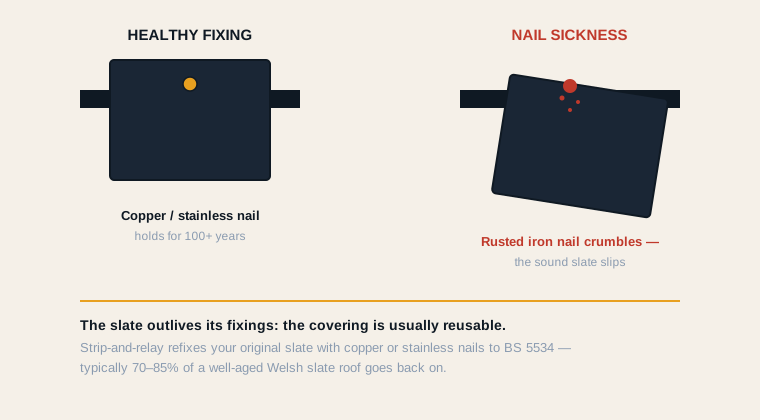
A full re-roof is the right call when the problem is the whole roof, not one part of it — and on Reading's post-war estates, advancing nail sickness makes that a common verdict.
Tiles slipping in different places after every windy spell
Multiple leaks appearing in separate areas
A roof over 50-60 years old on its original covering
Sagging rooflines or visibly failing battens
Repeated repairs that no longer hold
When it is not the answer: If the covering is sound and only the fixings or a single slope have failed, a re-roof is oversell — a partial re-cover or repair is the honest, cheaper fix. Read the full guide.
We assess the covering, timber and underlay, and advise on tile type suited to your property era — concrete interlocking on estate stock, clay plain tile in conservation Newtown and Caversham.
2. Written itemised quote
A clear breakdown: scaffold, strip and disposal, timber, underlay, tiles, ridge and verge, labour — no surprises.
3. Scheduling & scaffold
We book the job and arrange scaffold; you get a realistic programme up front.
4. Strip & re-roof
We strip the old covering, replace any rotten timber (documented with photos), fit breathable underlay, treated battens, new tiles and dry-fix ridge and verge.
5. Cleanup & guarantee handover
Full site clearance, waste removal, and a 10-year written workmanship guarantee.
Timescales
Typical Timescales
Job
Typical duration
Terraced house re-roof
3-5 days
3-bed semi re-roof
5-8 days
Detached house re-roof
1-2 weeks
Rotten timber replacement (added)
0.5-1 day
Scaffold erection
1 day
Prolonged rain or high wind extends the programme — we never leave a stripped roof exposed overnight and always leave it weathertight.
Access
Access, Scaffolding & Permits in Southcote
A full re-roof always needs scaffold for safe working and material handling — it is included and itemised in your quote. Scaffold is specified for: the whole job — full perimeter scaffold is standard on every re-roof - always itemised in your written quote, never a hidden extra, and we arrange it.
Southcote is a post-war concrete-tile estate on open plots beside the Kennet watermeadows — good driveway access, with damp low-lying ground. Pavement scaffold and skip permits go through Reading Borough Council; allow a few working days on streets like the estate roads across Southcote where space is tight.
Pricing
What Roof Replacement Costs in Reading
Job
Typical range
Notes
Terraced house re-roof (concrete tile)
£4,000-£7,000
Incl. scaffold & waste
3-bed semi re-roof (concrete tile)
£5,500-£9,000
Standard estate stock
3-bed semi re-roof (clay, conservation)
£7,500-£12,000
Newtown/Caversham matching
Detached house re-roof (concrete)
£9,000-£14,000
Size and roofline dependent
Detached / period (clay or slate)
£12,000-£18,000
Premium materials
Rotten timber replacement
£80-£200
Per rafter end, if found
What moves the price
Tile specification (concrete vs clay vs slate)
Roof size and complexity (hips, valleys, dormers)
Scaffold requirements and street access
Structural timber condition found at strip
Conservation-area material requirements
Worked example: A 1965 semi on a Whitley estate road, concrete interlocking tile, straightforward driveway access, two rotten rafter ends replaced, scaffold and skip included: £6,800-£8,200 with a 10-year guarantee.
Staged payments on re-roofs — a materials payment when they arrive on site, the balance on completion. Nothing up front before materials are delivered. All prices include VAT.
Guarantee
What the 10-Year Guarantee Actually Covers
The complete re-roof carries a 10-year written workmanship guarantee, transferable if you sell; tiles and membrane carry their own manufacturer warranties on top.
Covered: workmanship for 10 years, in writing, transferable if you sell.
On top: manufacturer warranties on materials (terms vary by product).
Not covered: storm or impact damage - that is an insurance matter, and we will document it for your claim.
If a fault appears in covered work, we come back and put it right. No quibbling, no re-charge.
Covering RG30 and surrounding postcodes.
Good to know
What It Is Like While We Work
Scaffold goes up for the duration and there is noise during the strip; we protect the garden and drive, sheet the scaffold, and clear all waste by skip. You do not need to stay home for external work - we just need power and access agreed in advance.
Re-roofs run in most conditions but tiling pauses in heavy rain or high wind; we phase the strip so only a weatherproofable area is ever open. Beside the Kennet watermeadows, Southcote roofs see accelerated moss and damp on north-facing slopes.
FAQ
Common Questions
A full re-roof on a standard 3-bed semi-detached in Southcote typically costs £5,000–£7,500 using concrete tile, or £7,500–£12,000 for clay or natural slate. Prices include scaffolding, strip, new battens and underlay, tiles, dry-fix ridge, and lead flashings. We provide free surveys and itemised written quotes.
A standard 3-bed semi re-roof in Southcote takes 4 to 6 working days. We work Monday to Saturday, protect the roof with scaffold sheeting overnight, and keep you informed of any weather-related delays. You receive a written programme before work starts.
Concrete plain tile or concrete interlocking is the correct specification for Southcote's post-war stock — original profiles are well-matched by modern Marley and Redland equivalents. We specify the correct material for your property type and era at survey, and advise on any planning or conservation requirements that apply to your specific address.
For like-for-like tile replacement on a standard residential property in Southcote, no planning permission is required. Conservation area properties, listed buildings, or any job involving a material change may need consent. We check the planning position for your address at survey and advise before materials are ordered.
We provide a 10-year written workmanship guarantee on all re-roofing work across Southcote and the surrounding RG30 area. Tile manufacturers provide separate product guarantees — typically 30 to 50 years on concrete tile and 30 to 40 years on clay. Both are provided in writing before work starts.
Yes. The property remains fully habitable throughout. We use scaffold sheeting to protect the interior if there is any rain risk during the strip phase, and internal temperatures are not significantly affected during a standard UK re-roof. We advise securing any fragile items in the loft before the strip begins.
All waste is handled by us — old concrete tiles go to licensed waste transfer stations. Sound reclaimed clay tiles and natural slate are offered to reclamation yards where viable. Lead is recycled. There is nothing for you to arrange — waste disposal is included in our quote price.
Why Southcote Specifically
Roof Replacement in Southcote — Local Conditions
Southcote occupies low-lying ground between the Kennet and the Bath Road, at 35 to 50 metres above sea level. The proximity to the Kennet watermeadows creates elevated humidity across the southern sections of the postcode — similar to the Theale valley position but within a larger urban area. Properties bordering the Kennet corridor, particularly those on Buckland Road and Henley Road south of the railway, see notably faster moss growth than higher-ground Reading suburbs.
Southcote's housing stock spans the post-war decades. The oldest sections along Lyndhurst Road and Buckland Road date from the late 1940s and early 1950s — concrete plain tile on original iron nails now approaching 70 years old. The 1960s expansion through to the mid-1970s introduced interlocking concrete tile. More recent infill development from the 1990s is modern concrete on stainless fixings. The low-lying streets closest to the Kennet have the highest humidity exposure and the most pronounced biological growth on roof surfaces.
For roof replacement work in Southcote, this translates directly into how we approach the job. The combination of age and humidity makes Southcote one of Reading's higher-maintenance postcodes for roofing. Nail fatigue on the oldest 1950s stock is more advanced than equivalent-age properties in drier locations. Moss and algae growth on north and west-facing slopes requires more frequent treatment than the drier ridge suburbs. Valley blockages are a consistent autumn issue across the Kennet-adjacent streets. These are not issues we encounter occasionally — they are the characteristic call types from the RG30 postcode and our teams have the materials and experience to address them correctly on the first visit.
Southcote has strong year-round demand for maintenance work — the humidity factor means moss treatment and gutter maintenance is needed more frequently here than elsewhere in Reading. Re-roof survey requests peak in spring and early summer. Knowing this seasonal pattern means we can give you a realistic timeline for booking work in Southcote — and advise you if your situation warrants treating the job as more urgent.
Free survey in Southcote RG30 — call 0118 327 2383 to arrange. No call-out fee, written quote before any work starts.
The Re-Roofing Process on a Reading Property
A full re-roof on a Reading property typically takes three to five days from scaffold erection to completion for a standard three-bedroom semi-detached. We begin by erecting scaffold and covering the property with a temporary weathering sheet before any tiles are stripped. This means the building interior is protected regardless of weather during the stripping phase.
Stripping proceeds methodically from ridge to eaves. All old tiles, mortar and battens are cleared and loaded directly into a skip. The deck is then fully inspected — we check every rafter end for rot, the wall plate condition, and the condition of any existing insulation. Any rotten timber is replaced at this stage, not concealed under new material. We photograph the deck before any new material goes on.
New BS 5534-compliant underlay is fixed to the deck, new treated battens are nailed at the correct gauge for the new tile system, and tiling proceeds from eave to ridge. Ridge and hip tiles are fixed using dry-fix mechanical fixings on all re-roofs — we do not install new mortar-bedded ridges on replacement work. The result is a system that requires no maintenance for the life of the roof.
Specification Decisions That Matter
The tile choice on a Reading re-roof is driven by the property's era, planning status, and pitch. Conservation area properties in Newtown, central Caversham and parts of Katesgrove require clay plain tile or natural slate — concrete tile is not accepted. For properties outside conservation areas on pitches above 22.5 degrees, both clay and concrete are structurally appropriate and the decision is driven by budget, character, and desired lifespan.
Underlays specified to current BS 5534 standards are required for all re-roofs. High-performance breathable membranes are now standard on all our re-roofs — they outperform traditional felt in both condensation management and longevity, and they are required to qualify for full manufacturer tile guarantees. We do not specify traditional bituminous felt on new work.
Get In Touch
Free Quote — No Obligation
No call-out fees. No hidden costs. A straight answer from a local Southcote roofer.