Ridge tile repairs, repointing and dry-fix conversion across Tilehurst and the surrounding RG31 area. Mortar or mechanical fix — specified correctly for your property. Free surveys, no call-out fee.
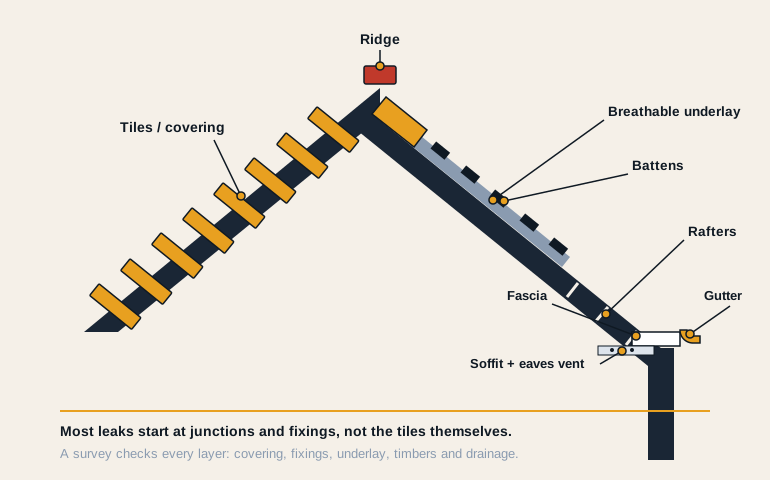
Ridge tiles sit at the apex of the roof and are bedded onto a mortar course. That mortar has a finite life — typically 15 to 25 years before cracking, spalling or shrinking away from the tile surface. On Tilehurst's 1930s semi-detached and pre-war housing stock, ridge mortar that has never been touched may be approaching or past this threshold.
The choice between repointing and dry-fix conversion depends on the ridge's history and remaining condition. A ridge repointed once with sound mortar that is just beginning to crack is a good candidate for quality repointing. A ridge that has been repointed twice in 20 years, or where the mortar is cracked across the full run, is better served by dry-fix conversion — which eliminates the maintenance cycle entirely. We assess and advise honestly on which is appropriate.
Dry-fix ridge systems use stainless steel mechanical fixings rather than mortar. The ridge tiles cannot lift in wind, there is no mortar to crack, and the system lasts the life of the roof. For Tilehurst properties on exposed positions, dry-fix is our standard recommendation.
“Ridge tiles were rocking after the wind — called in the morning and someone was here by the afternoon. Made safe, repointed the whole ridge while they were there. Efficient and exactly as quoted.”
Patricia W. · Norcot Road, Tilehurst RG31
★★★★★
“Had the ridge repointed twice in ten years by previous companies — both failed within 18 months. Reading Roofing Experts converted to dry-fix. Two years on and no movement at all. Should have done it years ago.”
Alan C. · School Road, Tilehurst RG31
★★★★★
“Three loose ridge tiles after a storm. Called and they confirmed an ETA within the hour. Fixed same day, full ridge inspection done at no extra charge. Professional.”
Sandra M. · Kentwood Hill, Tilehurst RG31
Honest advice
Do You Actually Need Roof Repairs?
Most Reading roof problems announce themselves indoors first — a stain, a drip, a patch of damp — long before the cause is visible from the ground. The trick is tracing the symptom back to the actual fault.
A damp patch or brown stain on an upstairs ceiling after rain
A slipped, cracked or missing tile visible from the ground
Water tracking down a chimney breast or around a rooflight
Debris (mortar, tile fragments) in the gutters or on the drive
Daylight visible through the roof from inside the loft
When it is not the answer: If more than about a third of the covering has failed — widespread nail sickness on a 1960s-70s Whitley or Southcote estate roof, for instance — repairing tile-by-tile is money wasted. Read the full guide.
We inspect from roof level, lift sample tiles to check the fixings and underlay, and trace the leak to its real source — not the nearest visible symptom.
2. Written itemised quote
You get a fixed, written price naming the fault, the fix and the guarantee — no lump-sum guesswork.
3. Scheduling
We agree a date; for common faults we carry matching materials to fix on the first visit.
4. The repair
We carry out the work, document any hidden damage found with photos, and make the roof weathertight.
5. Cleanup & sign-off
We clear debris, leave the site tidy, and hand over the written workmanship guarantee.
Timescales
Typical Timescales
Job
Typical duration
Slipped or cracked tile refix
1-2 hours
Lead flashing repair
Half a day
Section of nail-sick tiles refixed
Half to full day
Rear valley rebuild
1-2 days
Chimney flashing renewal
1 day
Wet or high-wind days pause tiling and lead work — we build weather margin into every booking and never leave a roof open overnight.
Access
Access, Scaffolding & Permits in Tilehurst
Most Reading repairs run from roof ladders or a tower; scaffold is quoted only where the job needs safe standing time at height. Scaffold is specified for: chimney-side repairs, full valley rebuilds, ridge work on exposed Tilehurst and Caversham Heights streets, or anything beyond a day at height - always itemised in your written quote, never a hidden extra, and we arrange it.
The Tilehurst ridge sits at 70-80m and takes the prevailing south-westerly directly; exposed gable and ridge access needs proper scaffold on the higher streets. Pavement scaffold and skip permits go through Reading Borough Council; allow a few working days on streets like Norcot Road, School Road where space is tight.
Pricing
What Roof Repairs Costs in Reading
Job
Typical range
Notes
Slipped or cracked tile refix
£150-£300
Per visit incl. access
Lead flashing repair / renewal
£280-£800
Chimney or abutment
Section of nail-sick tiles refixed
£300-£600
Signals wider issue
Valley renewal
£400-£1,200
Depending on length
Ridge repointing (per run)
£300-£1,000
Exposed stock weathers faster
Emergency make-safe call-out
£150-£450
Same-day, stated up front
What moves the price
Roof height and access (bungalow vs three-storey terrace)
Whether the tile needs matching (clay in Newtown/Caversham costs more than concrete)
Scaffold vs tower vs ladder for the specific fault
How far the leak has tracked before it was caught
Hidden timber rot found once tiles are lifted
Worked example: A rear valley rebuild on a 1930s semi off the Wokingham Road, concrete tile, tower access: around £680 including access and waste removal.
No deposit on repairs under £500. Staged payments on larger jobs — nothing up front before materials are on site. All prices include VAT.
Guarantee
What the 10-Year Guarantee Actually Covers
Workmanship on the repaired section is covered for 10 years in writing; any replacement tiles and lead carry manufacturer warranties on top.
Covered: workmanship for 10 years, in writing, transferable if you sell.
On top: manufacturer warranties on materials (terms vary by product).
Not covered: storm or impact damage - that is an insurance matter, and we will document it for your claim.
If a fault appears in covered work, we come back and put it right. No quibbling, no re-charge.
Covering RG30, RG31 and surrounding postcodes.
Good to know
What It Is Like While We Work
A day of ladder or tower work and a small amount of tile debris — we sheet below the work area and clear everything before we leave. You do not need to stay home for external work - we just need power and access agreed in advance.
Repairs run year-round; temporary weatherproofing goes on the same day if rain stops work mid-job. Elevated and wind-exposed — the Tilehurst ridge weathers ridge mortar and chimney pointing faster than sheltered valley stock.
FAQ
Common Questions
Single ridge tile rebed in Tilehurst costs £150 to £250. Full ridge repointing on a 3-bed semi runs £500 to £900. Dry-fix conversion costs £900 to £1,800 depending on ridge length. We provide free, no-obligation surveys and written quotes across RG31.
If this is the second or third time the ridge has needed attention in 20 years, dry-fix conversion is better value — it eliminates the maintenance cycle entirely. For a ridge with sound original mortar showing early cracking, quality repointing with a flexible mortar compound is a reasonable call. We assess and advise honestly.
Visual signs from the ground: gaps between the ridge tile and the roof slope, sections sitting at a different angle to the rest of the run, or mortar that has visibly dropped away. After a storm, displaced ridge tiles are sometimes audible from inside as a low clunking sound in high winds. If you can see daylight gaps along the ridge, call us.
Yes. A partially dislodged ridge tile is both a water ingress risk and a falling object hazard weighing 4 to 7kg. In high winds, a tile that is half-off can become fully off very quickly. Call us on 0118 327 2383 and we will attend the same day.
For a full ridge run, yes — a working platform at ridge height is required for safe, extended work. For emergency single-tile make-safe we use a properly anchored ladder with fall arrest for an initial visit, with scaffold following for the full repair. Scaffolding is included in our ridge repair quotes.
Quality repointing with a flexible lime or polymer-modified mortar lasts 10 to 20 years in typical conditions. Exposed positions in Tilehurst — particularly ridge-top streets — may see slightly faster weathering. Dry-fix conversion avoids the mortar maintenance cycle entirely and is our recommendation where repointing has been needed more than once in 15 years.
Yes. We strip the existing mortar bed, fit the dry-fix batten system and mechanical fixings, and refit the ridge tiles. The work is done from scaffold and takes one to two days on a standard Tilehurst semi. The result is a ridge that requires no maintenance for the remaining life of the roof.
Why Tilehurst Specifically
Ridge Tile Repair in Tilehurst — Local Conditions
Tilehurst occupies the elevated ridge west of Reading town centre, reaching 70 to 90 metres above sea level on the upper streets around Norcot Road, School Road and Kentwood Hill. This is one of the most exposed residential positions in the Reading catchment — south-westerly Atlantic weather arrives at Tilehurst before it reaches the valley floor, and wind speeds during storm events are consistently higher here than in central Reading. The elevated position also creates a frost pocket effect in winter, with the ridge streets experiencing more freeze-thaw cycles per year than low-lying Reading suburbs.
The dominant era in Tilehurst is 1920s to 1940s semi-detached, built during the inter-war expansion of Reading westward along the Bath Road corridor. These properties are on clay plain tile — original to the 1930s build, now 85 to 95 years old — with concrete plain tile on some post-war infill. The ridge position and the age of the stock create a specific vulnerability: mortar-bedded ridges on 1930s properties at the exposed ridge-top streets are typically 20 to 30 years past their last repointing requirement. Chimney stacks on these properties are large, shared-flue designs requiring specific access.
For ridge tile repair work in Tilehurst, this translates directly into how we approach the job. Ridge mortar failure is the defining repair type in Tilehurst — the exposure at the ridge-top streets accelerates mortar weathering significantly compared to sheltered Reading suburbs. Clay plain tile nail fatigue on the oldest stock, chimney stack repointing and lead flashing renewal on prominent stacks, and post-storm emergency call-outs from the most exposed streets are the characteristic call types from this postcode. These are not issues we encounter occasionally — they are the characteristic call types from the RG31 postcode and our teams have the materials and experience to address them correctly on the first visit.
Autumn and winter are high-demand periods in Tilehurst — the exposed ridge position means storm-related call-outs (displaced ridge tiles, cracked mortar, lifted tiles) peak between October and February. Spring survey season follows as homeowners assess winter damage. Knowing this seasonal pattern means we can give you a realistic timeline for booking work in Tilehurst — and advise you if your situation warrants treating the job as more urgent.
Free survey in Tilehurst RG31 — call 0118 327 2383 to arrange. No call-out fee, written quote before any work starts.
Ridge Tile Repair Across Reading
Ridge tiles are the highest and most exposed element of any pitched roof. On Reading's 1930s stock — particularly the Tilehurst ridge streets, Emmer Green and parts of Caversham Heights — the mortar bedding these tiles has often not been touched since the original build. After 85 to 90 years of thermal movement, freeze-thaw cycling and weather exposure at elevation, this mortar is typically cracked along its full length.
We distinguish between repointing — removing and replacing the mortar bed on a ridge that is otherwise structurally sound — and dry-fix conversion, which replaces the mortar bed with mechanical fixings. Repointing is appropriate where the ridge tiles themselves are in good condition and this is the first time the ridge has needed attention. Dry-fix is appropriate where the ridge has been repointed before, where the exposure is high enough that mortar cycles will be short, or where the client wants to eliminate future maintenance.
All dry-fix ridge systems we install use stainless steel mechanical fixings into the batten below — not polymer pins or adhesive systems. Scaffold is required for all ridge work and is included in our quotes. We do not carry out ridge work from ladders.
Dry-Fix vs Mortar — the Honest Assessment
Dry-fix ridge systems cost more upfront — typically 50 to 100 percent more than a quality repoint. Over the life of the roof, dry-fix is cheaper because you do not pay for the job again in 15 to 20 years. For properties on the exposed Tilehurst and Emmer Green ridge streets, we estimate a mortar ridge needs attention every 12 to 18 years given the weather exposure. A dry-fix system on the same property requires no maintenance for the life of the roof.
Where a client chooses repointing over dry-fix for budget reasons, we use a polymer-modified flexible mortar compound rather than a standard cement-based mix. Flexible mortar accommodates more movement before cracking and extends the repoint cycle by three to five years compared to rigid cement.
Get In Touch
Free Quote — No Obligation
No call-out fees. No hidden costs. A straight answer from a local Tilehurst roofer.