Chimney repointing, lead flashing replacement and stack repairs across Tilehurst and the surrounding RG31 area. Permanent fixes — not mortar patches that fail within a year. Free surveys with no call-out fee.
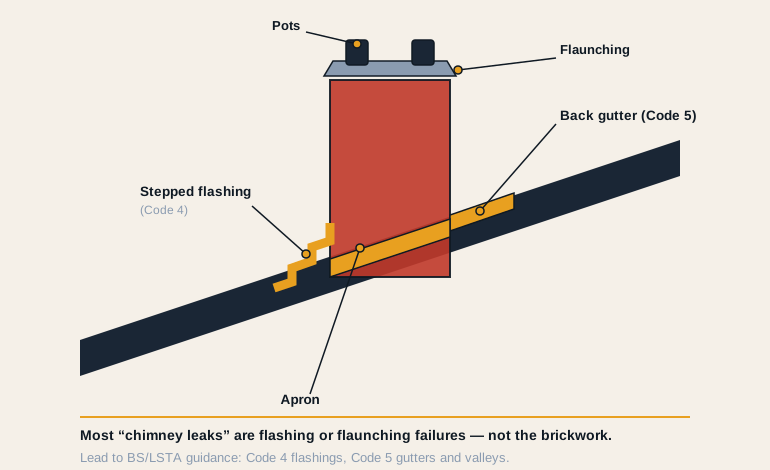
The chimney repair issues most common on Tilehurst's 1930s semi-detached and pre-war housing stock are: ridge mortar failure accelerated by south-westerly wind exposure at altitude, lead apron and step flashing failure on north-facing chimney stacks, lime mortar deterioration on Victorian-era chimney stacks in the older Tilehurst streets. We carry out permanent repairs using the correct materials for each property era — lime mortar on pre-war brickwork, code 4 and code 5 lead for flashing replacements, and correct clay or concrete tile profiles for surround work.
The majority of persistent chimney leaks in Tilehurst result from previous repairs that applied mortar over lead flashings rather than replacing the lead. Mortar cracks within one to two thermal cycles as the lead moves seasonally beneath it. We strip these patches, replace the lead correctly, and repoint only with flexible mortar. This is a repair that stays repaired.
“Chimney breast damp patch that had been patched twice with no lasting result. The team stripped the old mortar patches, replaced the lead step flashings properly, and repointed the stack with lime mortar. The patch has gone and stayed gone. Should have called them first.”
Janet R. · Norcot Road, Tilehurst RG31
★★★★★
“Full chimney stack repoint on our 1930s semi. Lime mortar as requested, matching the original colour closely. Job done in a day, scaffold up and down same week. Clean, professional and priced fairly.”
Tom K. · School Road, Tilehurst RG31
★★★★★
“Had three estimates for chimney flashing replacement. Reading Roofing Experts were the only ones who explained why the mortar repair had failed before and what the correct fix involved. That gave us confidence. The work was exactly as described.”
Anne S. · Kentwood Hill, Tilehurst RG31
Honest advice
Do You Actually Need Chimney Repairs?
Chimney faults show as damp on the breast, staining at ceiling level near the stack, or debris in the fireplace — concentrated on Reading's Victorian stacks in Newtown and Caversham and exposed Tilehurst ridge stacks.
Damp patch on the chimney breast, inside or upstairs
Crumbling or missing mortar between the stack bricks
Cracked or missing flaunching (the mortar bed at the top)
Leaning or loose chimney pots
White staining (efflorescence) on the stack brickwork
When it is not the answer: If only the pointing has weathered, repointing is enough — a full rebuild is oversell unless the brickwork itself has spalled and failed. Read the full guide.
We assess the pointing, flaunching, pots, flashings and flue from a safe standing position, not guessed from the ground.
2. Written quote
A clear price naming the mortar spec — lime for pre-1940 Newtown and Caversham stacks — and the scope.
3. Scheduling & scaffold
We book the work and arrange scaffold or a tower as the stack needs.
4. The work
Repointing, flaunching renewal, flashing repair, pot re-set or cowl fitting as agreed.
5. Cleanup & guarantee
Site cleared and the stack left weathertight with a written guarantee.
Timescales
Typical Timescales
Job
Typical duration
Chimney repointing (per stack)
1-2 days
Flaunching renewal
Half a day
Lead flashing renewal
Half to full day
Pot re-set or cowl fitting
2-4 hours
Upper-course rebuild
2-3 days
Lime mortar on period stacks needs dry conditions to cure properly, so we weather-plan pointing on Newtown and Caversham chimneys.
Access
Access, Scaffolding & Permits in Tilehurst
Chimney work always needs proper scaffold or a suitable tower — never ladder work — for safe assessment and repair. Scaffold is specified for: all chimney work — safe standing access to the stack is essential and included in the quote - always itemised in your written quote, never a hidden extra, and we arrange it.
The Tilehurst ridge sits at 70-80m and takes the prevailing south-westerly directly; exposed gable and ridge access needs proper scaffold on the higher streets. Pavement scaffold and skip permits go through Reading Borough Council; allow a few working days on streets like Norcot Road, School Road where space is tight.
Pricing
What Chimney Repairs Costs in Reading
Job
Typical range
Notes
Chimney repointing (per stack)
£150-£800
Scope dependent
Flaunching renewal
£150-£400
Mortar bed at the top
Lead flashing repair
£280-£700
Around the stack
Pot re-set or cowl fitting
£80-£200
Per pot
Chimney capping (redundant flue)
£150-£450
Ventilated cap
Upper-course rebuild
£500-£1,500
Where brick has failed
What moves the price
Stack height and exposure (Tilehurst ridge weathers fastest)
Mortar spec — lime for pre-1940 stacks costs more but is essential
Scaffold access to the stack
Extent of pointing vs full rebuild
Lead flashing renewal alongside
Worked example: Repointing a Victorian stack in Newtown in NHL lime mortar with scaffold access and two pots re-set: around £620 including scaffold.
No deposit on repointing and small chimney repairs. Staged payment on rebuilds. All prices include VAT.
Guarantee
What the 10-Year Guarantee Actually Covers
Chimney workmanship is covered for 10 years in writing; lead and materials carry their own warranties.
Covered: workmanship for 10 years, in writing, transferable if you sell.
On top: manufacturer warranties on materials (terms vary by product).
Not covered: storm or impact damage - that is an insurance matter, and we will document it for your claim.
If a fault appears in covered work, we come back and put it right. No quibbling, no re-charge.
Covering RG30, RG31 and surrounding postcodes.
Good to know
What It Is Like While We Work
Scaffold to the stack for the duration and some noise during raking-out; we sheet the roof below and clear all debris. You do not need to stay home for external work - we just need power and access agreed in advance.
Runs year-round, but lime mortar pointing needs dry, mild spells to cure; we schedule period-stack work accordingly. Elevated and wind-exposed — the Tilehurst ridge weathers ridge mortar and chimney pointing faster than sheltered valley stock.
FAQ
Common Questions
Chimney stack repointing on a standard Tilehurst property typically costs £280 to £600 depending on stack size and access. Full lead flashing replacement at the chimney runs £380 to £700. We provide free, no-obligation surveys and written quotes across the RG31 area.
Visible signs from the ground: recessed or missing mortar joints between bricks, brick faces spalling or flaking, white salt deposits (efflorescence) tracking down the stack after rain, and any visible lean or movement. From inside: damp patches on the chimney breast appearing after rain. We inspect chimneys free of charge as part of any roofing survey across Tilehurst.
The most common cause of persistent chimney leaks in Tilehurst is mortar applied over lead flashings rather than lead replacement. Mortar cannot accommodate lead's seasonal thermal movement and cracks within one to two years. The ridge mortar failure accelerated by south-westerly wind exposure at altitude is the most frequent failure type we see in Tilehurst. Correct lead replacement — not mortar patching — is the only lasting fix.
For 1930s semi-detached and pre-war properties in Tilehurst, the correct mortar specification depends on the original brick hardness. Pre-1950 brickwork generally requires hydraulic lime to allow moisture movement without causing spalling. Post-1950 harder brick can accept a stiffer hydraulic lime or flexible mortar compound. We assess the original mortar and specify accordingly on every job.
For straightforward pot replacement on a standard height Tilehurst property, a properly anchored ladder system with fall arrest is used for an initial assessment. Full pot replacement and any repointing work requires a scaffold platform at chimney level. We include the correct access in our quote — no surprises on the day.
Yes — disused chimney stacks should be capped and ventilated to prevent water ingress while maintaining air circulation to avoid condensation in the flue. An uncapped disused chimney in Tilehurst will eventually allow water to track down the flue to the fireplace opening, causing damp and eventual structural damage to the stack. We fit ventilated chimney caps across all Tilehurst property types.
Sudden damage to a chimney stack — caused by storm, lightning, or vehicle impact — is generally covered by buildings insurance. Gradual deterioration from weathering is typically not covered and is the homeowner's maintenance responsibility. We provide written surveys that help establish whether damage was sudden or gradual where an insurance question arises.
Why Tilehurst Specifically
Chimney Repairs in Tilehurst — Local Conditions
Tilehurst occupies the elevated ridge west of Reading town centre, reaching 70 to 90 metres above sea level on the upper streets around Norcot Road, School Road and Kentwood Hill. This is one of the most exposed residential positions in the Reading catchment — south-westerly Atlantic weather arrives at Tilehurst before it reaches the valley floor, and wind speeds during storm events are consistently higher here than in central Reading. The elevated position also creates a frost pocket effect in winter, with the ridge streets experiencing more freeze-thaw cycles per year than low-lying Reading suburbs.
The dominant era in Tilehurst is 1920s to 1940s semi-detached, built during the inter-war expansion of Reading westward along the Bath Road corridor. These properties are on clay plain tile — original to the 1930s build, now 85 to 95 years old — with concrete plain tile on some post-war infill. The ridge position and the age of the stock create a specific vulnerability: mortar-bedded ridges on 1930s properties at the exposed ridge-top streets are typically 20 to 30 years past their last repointing requirement. Chimney stacks on these properties are large, shared-flue designs requiring specific access.
For chimney repairs work in Tilehurst, this translates directly into how we approach the job. Ridge mortar failure is the defining repair type in Tilehurst — the exposure at the ridge-top streets accelerates mortar weathering significantly compared to sheltered Reading suburbs. Clay plain tile nail fatigue on the oldest stock, chimney stack repointing and lead flashing renewal on prominent stacks, and post-storm emergency call-outs from the most exposed streets are the characteristic call types from this postcode. These are not issues we encounter occasionally — they are the characteristic call types from the RG31 postcode and our teams have the materials and experience to address them correctly on the first visit.
Autumn and winter are high-demand periods in Tilehurst — the exposed ridge position means storm-related call-outs (displaced ridge tiles, cracked mortar, lifted tiles) peak between October and February. Spring survey season follows as homeowners assess winter damage. Knowing this seasonal pattern means we can give you a realistic timeline for booking work in Tilehurst — and advise you if your situation warrants treating the job as more urgent.
Free survey in Tilehurst RG31 — call 0118 327 2383 to arrange. No call-out fee, written quote before any work starts.
Chimney Repair on Reading Properties
Chimney repair in Reading is primarily a specialist job on period stock. The Victorian and Edwardian terraces of Newtown, Katesgrove and Caversham have chimney stacks that are 100 to 120 years old — large, multi-flue stacks built from soft stock brick in lime mortar, with lead step flashings and back gutters that were originally installed when the properties were built. These are not standard flat-rate repairs.
We assess chimney condition from scaffold — the only way to properly examine stack pointing, chimney pot security, lead flashing condition and the haunching mortar around the pot base. A CCTV inspection of the flue interior can be arranged where structural condition is in question, though this is more relevant to active chimney use than to weathertightness.
Pointing specification is critical on period chimneys. The lime-bonded soft brick of Reading's Victorian stock cannot accept Portland cement mortar — the cement is harder than the brick, and moisture trapped between cement repointing and soft brick causes spalling that destroys the brick face. We use NHL 3.5 hydraulic lime mortar on pre-1940 chimneys as standard, and document this in the written quote.
Lead Flashing and Haunching
The most common chimney repair call in Reading is lead flashing failure — specifically, mortar applied over original lead flashings that has dried, cracked, and allowed water into the void behind. The correct repair is stripping the mortar, replacing the lead, and wedging the new lead correctly into the brick joint. This is the fix that stays fixed. Mortar over lead is a temporary solution that fails every one to two thermal cycles.
Haunching mortar — the bedding around chimney pots — typically has a lifespan of 20 to 30 years before cracking. We replace haunching with a correctly specified flexible lime or polymer mortar compound, cut cleanly to allow proper weathering. The alternative, patching cracked haunching with additional mortar, adds weight to already degraded material and fails within two to three years.
Get In Touch
Free Quote — No Obligation
No call-out fees. No hidden costs. A straight answer from a local Tilehurst roofer.