⭐ Victorian Chimney Specialists · Conservation Area Work · Free Quotes
Chimney Repairs Caversham
Chimney stack repairs on Caversham's Victorian and Edwardian stock require period-appropriate materials, lime-based mortars on older brickwork, and the ability to source matching clay pot profiles. We handle this work regularly across RG4.
Caversham's Victorian and Edwardian villas and terraces are characterised by prominent chimney stacks — often serving multiple fireplace openings — finished in the yellow or red Berkshire brick common to the period. These stacks are now 90–120 years old and the original lime mortar pointing has, in most cases, been repointed at some stage with sand-and-cement — an inappropriate material for older brickwork that is harder than the brick and causes spalling. We specify lime mortars appropriate to the brick age and porosity on Caversham period properties.
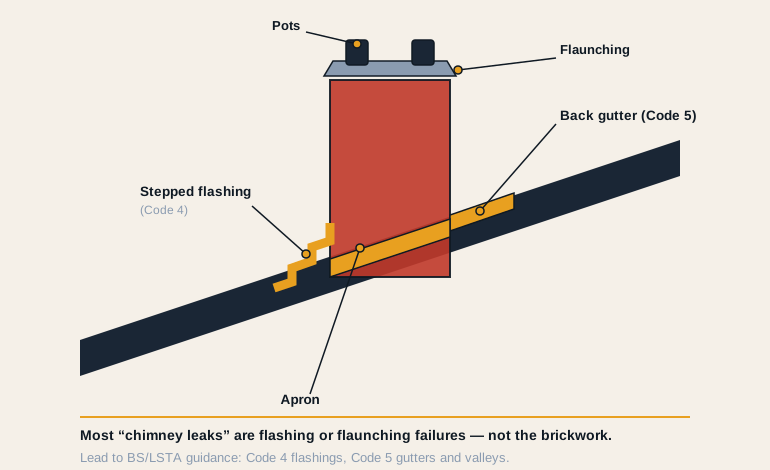
Lead flashing failure at chimney stacks is the most common cause of water ingress we diagnose in Caversham. The combination of mature garden trees shading north-facing chimneys, above-average Thames valley humidity, and flashings that are original to the property creates a high rate of lead failure compared to more modern construction. Mortar repair over original lead is the most common bodge we encounter — and the repair that fails fastest. We replace the lead.
Caversham Heights chimney stacks face additional challenges from wind exposure. The south-westerly weather driving into exposed Heights positions accelerates pointing failure on the windward faces of chimney stacks, and displaced chimney pots are more frequent than on valley-floor properties. Annual inspection of exposed chimney stacks in Caversham Heights is worthwhile.
“Damp on the chimney breast had been a mystery for three years. Two builders had looked at it and found nothing. Reading Roofing diagnosed it from the roof: failed step flashing combined with cracked pointing on the windward face. Both fixed, damp gone.”
Patricia L. · Caversham Heights, RG4
★★★★★
“Victorian chimney stack repointed in lime mortar — they were very clear that Portland cement would be wrong on this brickwork and explained why. Correct advice, well executed.”
Julia S. · Caversham village, RG4
★★★★★
“Chimney pot cracked and displaced in a storm — windy position on the Heights. Replaced with a matching terracotta pot and re-set in lime mortar. Exactly right for the property.”
Richard F. · Caversham Heights, RG4
Honest advice
Do You Actually Need Chimney Repairs?
Chimney faults show as damp on the breast, staining at ceiling level near the stack, or debris in the fireplace — concentrated on Reading's Victorian stacks in Newtown and Caversham and exposed Tilehurst ridge stacks.
Damp patch on the chimney breast, inside or upstairs
Crumbling or missing mortar between the stack bricks
Cracked or missing flaunching (the mortar bed at the top)
Leaning or loose chimney pots
White staining (efflorescence) on the stack brickwork
When it is not the answer: If only the pointing has weathered, repointing is enough — a full rebuild is oversell unless the brickwork itself has spalled and failed. Read the full guide.
We assess the pointing, flaunching, pots, flashings and flue from a safe standing position, not guessed from the ground.
2. Written quote
A clear price naming the mortar spec — lime for pre-1940 Newtown and Caversham stacks — and the scope.
3. Scheduling & scaffold
We book the work and arrange scaffold or a tower as the stack needs.
4. The work
Repointing, flaunching renewal, flashing repair, pot re-set or cowl fitting as agreed.
5. Cleanup & guarantee
Site cleared and the stack left weathertight with a written guarantee.
Timescales
Typical Timescales
Job
Typical duration
Chimney repointing (per stack)
1-2 days
Flaunching renewal
Half a day
Lead flashing renewal
Half to full day
Pot re-set or cowl fitting
2-4 hours
Upper-course rebuild
2-3 days
Lime mortar on period stacks needs dry conditions to cure properly, so we weather-plan pointing on Newtown and Caversham chimneys.
Access
Access, Scaffolding & Permits in Caversham
Chimney work always needs proper scaffold or a suitable tower — never ladder work — for safe assessment and repair. Scaffold is specified for: all chimney work — safe standing access to the stack is essential and included in the quote - always itemised in your written quote, never a hidden extra, and we arrange it.
Caversham combines Victorian and Edwardian villas near the centre with the elevated Caversham Heights, where mature tree canopy and sloping plots affect scaffold placement. Pavement scaffold and skip permits go through Reading Borough Council; allow a few working days on streets like the older streets off Caversham centre, roads around Caversham Heights where space is tight.
Pricing
What Chimney Repairs Costs in Reading
Job
Typical range
Notes
Chimney repointing (per stack)
£150-£800
Scope dependent
Flaunching renewal
£150-£400
Mortar bed at the top
Lead flashing repair
£280-£700
Around the stack
Pot re-set or cowl fitting
£80-£200
Per pot
Chimney capping (redundant flue)
£150-£450
Ventilated cap
Upper-course rebuild
£500-£1,500
Where brick has failed
What moves the price
Stack height and exposure (Tilehurst ridge weathers fastest)
Mortar spec — lime for pre-1940 stacks costs more but is essential
Scaffold access to the stack
Extent of pointing vs full rebuild
Lead flashing renewal alongside
Worked example: Repointing a Victorian stack in Newtown in NHL lime mortar with scaffold access and two pots re-set: around £620 including scaffold.
No deposit on repointing and small chimney repairs. Staged payment on rebuilds. All prices include VAT.
Guarantee
What the 10-Year Guarantee Actually Covers
Chimney workmanship is covered for 10 years in writing; lead and materials carry their own warranties.
Covered: workmanship for 10 years, in writing, transferable if you sell.
On top: manufacturer warranties on materials (terms vary by product).
Not covered: storm or impact damage - that is an insurance matter, and we will document it for your claim.
If a fault appears in covered work, we come back and put it right. No quibbling, no re-charge.
Covering RG4 and surrounding postcodes.
Good to know
What It Is Like While We Work
Scaffold to the stack for the duration and some noise during raking-out; we sheet the roof below and clear all debris. You do not need to stay home for external work - we just need power and access agreed in advance.
Runs year-round, but lime mortar pointing needs dry, mild spells to cure; we schedule period-stack work accordingly. Thames-side humidity and heavy tree canopy make Caversham roofs some of the mossiest in the borough.
FAQ
Common Questions
For Victorian and Edwardian properties in Caversham, lime mortar is the correct specification. Portland cement is harder than the original brick and prevents the normal movement and moisture release that lime accommodates — over time it causes brick face spalling. We use appropriate NHL (natural hydraulic lime) mortars on period Caversham properties.
Chimney repointing in Caversham typically costs £350–£700 depending on stack height, access and extent of pointing failure. Heights properties requiring longer ladder runs or scaffold access will be at the upper end. Free quotes provided.
Yes. We understand the material requirements that apply in Caversham's conservation area and can advise on whether any consent is needed for specific chimney repairs.
Yes. We source terracotta chimney pot profiles from specialist suppliers. For period Caversham properties, matching the original pot profile is usually achievable. We can also supply and fit ventilating cowls where required.
Caversham Heights properties sit on the exposed ridge above the Thames facing predominantly south-westerly weather. The combination of wind-driven rain, UV exposure, and thermal cycling at altitude is harder on chimney stack mortar and lead flashings than sheltered valley-floor conditions. Period properties with prominent chimney stacks are particularly exposed.
For Victorian and Edwardian terraces in Caversham where the chimney is on the front elevation, scaffold is erected on the street side. We coordinate with the local authority for any pavement licence required and include this in our quote.
Yes — for pre-1950 properties in Caversham, lime mortar is the correct specification. Portland cement applied to original soft Victorian brick accelerates deterioration. We use hydraulic lime mixes appropriate to the original construction on all period Caversham properties.
Why Caversham Specifically
Chimney Repairs in Caversham — Local Conditions
Caversham sits directly on the north bank of the Thames at approximately 40 to 55 metres above sea level. The river corridor creates elevated ambient humidity relative to higher Reading suburbs — properties within 200 metres of the Caversham waterfront see moss growth rates roughly 30 to 40 percent faster than equivalent properties on the Tilehurst ridge. The RG4 postcode also receives slightly heavier autumn rainfall than the Berkshire plateau, channelled by the Thames valley.
The dominant housing stock in Caversham is Victorian and Edwardian — terraced and semi-detached properties built between 1880 and 1930, predominantly on clay plain tile with original Welsh slate on higher-value Edwardian villas on Prospect Hill and the Caversham Heights ridge. Post-war infill through the 1950s and 1960s introduced some concrete plain tile on the estate sections off Caversham Road. Conservation area designations in the central Caversham streets require like-for-like clay tile on period properties.
For chimney repairs work in Caversham, this translates directly into how we approach the job. The most common repair call types from Caversham are lead flashing failure on chimney stacks — accelerated by Thames valley humidity — clay plain tile nail fatigue on 100-to-120-year-old stock, and valley blockage from seasonal leaf fall from the mature tree canopy covering much of Prospect Street and the riverside roads. These are not issues we encounter occasionally — they are the characteristic call types from the RG4 postcode and our teams have the materials and experience to address them correctly on the first visit.
Autumn is the highest-demand period in Caversham — leaf fall from riverside willows and mature garden trees blocks valleys and gutters simultaneously across the postcode, generating a concentrated burst of call-outs in October and November. Knowing this seasonal pattern means we can give you a realistic timeline for booking work in Caversham — and advise you if your situation warrants treating the job as more urgent.
Free survey in Caversham RG4 — call 0118 327 2383 to arrange. No call-out fee, written quote before any work starts.
Chimney Repair on Reading Properties
Chimney repair in Reading is primarily a specialist job on period stock. The Victorian and Edwardian terraces of Newtown, Katesgrove and Caversham have chimney stacks that are 100 to 120 years old — large, multi-flue stacks built from soft stock brick in lime mortar, with lead step flashings and back gutters that were originally installed when the properties were built. These are not standard flat-rate repairs.
We assess chimney condition from scaffold — the only way to properly examine stack pointing, chimney pot security, lead flashing condition and the haunching mortar around the pot base. A CCTV inspection of the flue interior can be arranged where structural condition is in question, though this is more relevant to active chimney use than to weathertightness.
Pointing specification is critical on period chimneys. The lime-bonded soft brick of Reading's Victorian stock cannot accept Portland cement mortar — the cement is harder than the brick, and moisture trapped between cement repointing and soft brick causes spalling that destroys the brick face. We use NHL 3.5 hydraulic lime mortar on pre-1940 chimneys as standard, and document this in the written quote.
Lead Flashing and Haunching
The most common chimney repair call in Reading is lead flashing failure — specifically, mortar applied over original lead flashings that has dried, cracked, and allowed water into the void behind. The correct repair is stripping the mortar, replacing the lead, and wedging the new lead correctly into the brick joint. This is the fix that stays fixed. Mortar over lead is a temporary solution that fails every one to two thermal cycles.
Haunching mortar — the bedding around chimney pots — typically has a lifespan of 20 to 30 years before cracking. We replace haunching with a correctly specified flexible lime or polymer mortar compound, cut cleanly to allow proper weathering. The alternative, patching cracked haunching with additional mortar, adds weight to already degraded material and fails within two to three years.
Get In Touch
Free Quote — No Obligation
No call-out fees. A straight answer from a local roofer who knows Caversham.