A straight answer on re-roofing costs across Reading and Berkshire — what drives the price, what a fair quote looks like for your street, and where the conservation-area and access premiums apply. No sales pressure, no hidden extras.
A new roof in Reading typically costs £5,500-£9,000 for a standard 3-bed semi on concrete tile, rising to £7,500-£12,000 for clay tile on conservation-area properties and £12,000-£15,000+ for larger detached homes. Price depends on tile type, roof size, access and scaffold. All quotes should follow a physical survey.
✓ NFRC Registered
✓ Fully Insured
✓ 10 Year Guarantee
✓ Free Quotes
✓ No Hidden Costs
✓ Family Run Since 2003
How It Works
What Goes Into a New Roof Price in Reading
The headline price of a re-roof is built from five components: scaffold, strip and disposal, structural repair, materials, and labour. On a standard Reading semi-detached, scaffold runs £600-£1,000, stripping and skip disposal £800-£1,400, new BS 5534 underlay and treated battens £600-£1,000, tiles £1,500-£4,000 depending on specification, and labour the balance. Understanding this breakdown is the single best defence against being overcharged — a quote that is a single lump sum with no itemisation hides where the money goes.
Tile specification is the largest single variable. Concrete interlocking tile — the standard on Reading's post-war estates — is the most economical at £1,500-£2,500 in materials for a semi. Clay plain tile, required on conservation-area Victorian properties in Newtown and central Caversham, runs £3,000-£4,500 for the same roof. Natural Welsh slate on Edwardian villas in Caversham Heights runs higher still. The labour to lay each is broadly similar; the material premium is real and unavoidable where planning requires it.
Structural condition discovered during the strip is the wildcard. On Reading properties where guttering has been overflowing for years — common on the older estate stock — rafter ends at the eaves are frequently found to have wet rot once tiles are removed. Replacing rotten timber is charged on an actuals basis and can add £300-£1,200 to a job. A reputable Reading roofer photographs the deck and documents any rot before proceeding, rather than concealing it or inflating a round-number allowance.
Local Knowledge
Re-Roof Costs by Reading Area
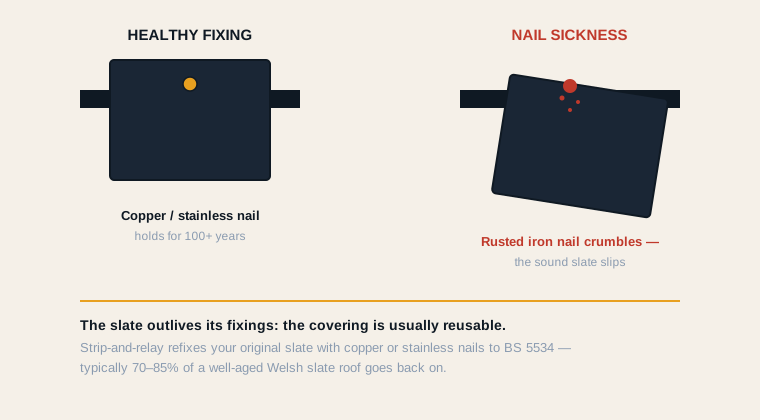
The cost of a new roof in Reading varies meaningfully by area because the housing stock and planning status vary. On the post-war estates — Whitley, Southcote, Woodley and Lower Earley — the dominant concrete interlocking tile keeps material costs down, and these standard semi-detached and terraced roofs with good road access are the most economical to re-roof, typically £5,500-£8,500. These are also the properties most likely to need a full re-roof rather than a repair, because the nail sickness affecting the 1958-1990 iron-nailed tile stock is a whole-roof problem.
In the conservation areas — Newtown, central Caversham, and the village cores of Theale and Pangbourne — the picture changes. Clay plain tile is required to match the Victorian and period stock, adding 20-40% to the material cost. A Newtown terrace re-roof that would cost £6,000 in concrete tile runs £7,500-£10,000 in matching clay. This is not a contractor markup — it is the actual cost of the material Reading Borough Council requires, and any quote offering concrete tile at a conservation address should be questioned on planning grounds.
Access is the third area factor. The mid-terrace properties of Newtown and Katesgrove often require scaffold that partially blocks narrow streets, sometimes needing a highway licence from Reading Borough Council and adding £400-£800 to the scaffold cost versus a detached property with driveway access. Conversely, the detached and semi-detached homes of Calcot, Emmer Green and the outer estates typically have straightforward access that keeps scaffold costs at the lower end. When comparing quotes, always confirm whether scaffold and any permit are included.
A worked example: a three-bedroom 1965 semi-detached on a Whitley estate road, concrete interlocking tile, straightforward driveway access, nail sickness confirmed across both slopes. Full strip, new breathable underlay, treated battens, matching Marley concrete tile, dry-fix ridge, two rotten rafter ends replaced, scaffold and skip included: £6,800-£8,200 all-in with a 10-year workmanship guarantee. The same specification on a detached property in Caversham Heights with clay tile and complex hip-ended roofline would run £12,000-£16,000.
Timing & Value
When to Re-Roof and How to Get Value in Reading
Timing a re-roof well saves money in Reading. The worst time to replace a roof is in an emergency after a failure — you lose negotiating position, you may pay for temporary make-safe on top, and you're forced into whatever contractor has availability. The best time is when a survey shows the roof is nearing the end of its life but still weathertight, giving you months to get comparative quotes, choose materials, and schedule the work for good weather. On Reading's post-war estates, where nail sickness gives years of warning through progressive tile slips, this planning window is genuinely available if you act on the early signs rather than ignoring them.
Value on a re-roof isn't the same as lowest price. The cheapest quote often omits scaffold, uses budget underlay that fails early, cuts the ridge and verge detailing that a 2018-standard roof requires, or leaves out ventilation. A roof re-covered without correct ventilation traps condensation in the void and rots the new timber — turning an apparent saving into an expensive problem within a decade. The value question is what you get for the price: BS 5534-compliant fixing, breathable underlay, dry-fix ridge and verge, correct ventilation, and a workmanship guarantee. A quote that includes all of these at a fair price beats a cheaper one that doesn't.
The Reading market has a wide spread of contractors, from national outfits to one-man operations, and the price range for the same job can be startling. This is exactly why an itemised, like-for-like comparison matters more here than a headline figure. A £6,500 quote and a £9,500 quote for the same Whitley semi may both be legitimate — the difference being clay versus concrete tile, or full scaffold versus tower access, or a 10-year versus 25-year guarantee. Understanding what drives your specific quote lets you make a genuine value decision rather than defaulting to the lowest number.
One further factor Reading homeowners should weigh is the knock-on saving a re-roof brings across the rest of the property. A sound new roof with correct ventilation ends the damp, condensation and interior damage that a failing roof causes — protecting decoration, insulation and timber below. Factored against those avoided costs, and the energy saving from a properly ventilated, well-insulated roof, the re-roof investment returns more than the headline price suggests, which is worth remembering when comparing the upfront figure against the temptation to patch a failing roof for another year or two.
Pricing
New Roof Price Guide — Reading 2026
Terraced house re-roof (concrete tile)
£4,000 – £7,000
3-bed semi re-roof (concrete tile)
£5,500 – £9,000
3-bed semi re-roof (clay tile, conservation)
£7,500 – £12,000
Detached house re-roof (concrete)
£9,000 – £14,000
Detached / period (clay or slate)
£12,000 – £18,000+
Rotten timber replacement (per rafter end)
£80 – £200
Scaffold (semi, standard access)
£600 – £1,000
Indicative 2026 ranges for the Reading area. Every roof is priced individually following a free physical survey. Figures include VAT, scaffold and waste disposal unless stated.
The current UK average cost for a full re-roof ranges from around £5,000 for a small terraced house to £15,000 or more for a large detached property, according to 2026 industry cost data — with tile specification and roof access the two largest variables driving where a specific job sits within that range.
Want an accurate re-roof price for your specific Reading property? A free survey gives you an itemised, no-obligation quote — not a phone estimate.
“They talked me through every line of the quote — scaffold, timber, tiles, the lot. No surprises, and the price didn't move when they found two rotten rafter ends because they'd already explained how that worked.”
David M.
Whitley · 3-bed semi re-roof
★★★★★
“We're in the Caversham conservation area so needed matching clay. They knew exactly what the council required and sourced the right tiles. Beautiful job, fair price for the specification.”
Sarah T.
Caversham · Clay tile re-roof
★★★★★
“Got three quotes. Theirs wasn't the cheapest headline but it was the only one that included scaffold and was itemised. Ended up the best value once I compared like for like.”
James P.
Lower Earley · Detached re-roof
Honest advice
Do You Actually Need Roof Replacement?
A full re-roof is the right call when the problem is the whole roof, not one part of it — and on Reading's post-war estates, advancing nail sickness makes that a common verdict.
Tiles slipping in different places after every windy spell
Multiple leaks appearing in separate areas
A roof over 50-60 years old on its original covering
Sagging rooflines or visibly failing battens
Repeated repairs that no longer hold
When it is not the answer: If the covering is sound and only the fixings or a single slope have failed, a re-roof is oversell — a partial re-cover or repair is the honest, cheaper fix. Read the full guide.
We assess the covering, timber and underlay, and advise on tile type suited to your property era — concrete interlocking on estate stock, clay plain tile in conservation Newtown and Caversham.
2. Written itemised quote
A clear breakdown: scaffold, strip and disposal, timber, underlay, tiles, ridge and verge, labour — no surprises.
3. Scheduling & scaffold
We book the job and arrange scaffold; you get a realistic programme up front.
4. Strip & re-roof
We strip the old covering, replace any rotten timber (documented with photos), fit breathable underlay, treated battens, new tiles and dry-fix ridge and verge.
5. Cleanup & guarantee handover
Full site clearance, waste removal, and a 10-year written workmanship guarantee.
Timescales
Typical Timescales
Job
Typical duration
Terraced house re-roof
3-5 days
3-bed semi re-roof
5-8 days
Detached house re-roof
1-2 weeks
Rotten timber replacement (added)
0.5-1 day
Scaffold erection
1 day
Prolonged rain or high wind extends the programme — we never leave a stripped roof exposed overnight and always leave it weathertight.
Access
Access, Scaffolding & Permits in Reading
A full re-roof always needs scaffold for safe working and material handling — it is included and itemised in your quote. Scaffold is specified for: the whole job — full perimeter scaffold is standard on every re-roof - always itemised in your written quote, never a hidden extra, and we arrange it.
Reading's mix of Victorian terraces in Newtown and Katesgrove and post-war estate housing in Whitley and Lower Earley means access varies from tight terraced frontages to open estate driveways. Pavement scaffold and skip permits go through Reading Borough Council; allow a few working days on streets like Newtown terraces off the Oxford Road, the narrow streets of Katesgrove where space is tight.
Pricing
What Roof Replacement Costs in Reading
Job
Typical range
Notes
Terraced house re-roof (concrete tile)
£4,000-£7,000
Incl. scaffold & waste
3-bed semi re-roof (concrete tile)
£5,500-£9,000
Standard estate stock
3-bed semi re-roof (clay, conservation)
£7,500-£12,000
Newtown/Caversham matching
Detached house re-roof (concrete)
£9,000-£14,000
Size and roofline dependent
Detached / period (clay or slate)
£12,000-£18,000
Premium materials
Rotten timber replacement
£80-£200
Per rafter end, if found
What moves the price
Tile specification (concrete vs clay vs slate)
Roof size and complexity (hips, valleys, dormers)
Scaffold requirements and street access
Structural timber condition found at strip
Conservation-area material requirements
Worked example: A 1965 semi on a Whitley estate road, concrete interlocking tile, straightforward driveway access, two rotten rafter ends replaced, scaffold and skip included: £6,800-£8,200 with a 10-year guarantee.
Staged payments on re-roofs — a materials payment when they arrive on site, the balance on completion. Nothing up front before materials are delivered. All prices include VAT.
Guarantee
What the 10-Year Guarantee Actually Covers
The complete re-roof carries a 10-year written workmanship guarantee, transferable if you sell; tiles and membrane carry their own manufacturer warranties on top.
Covered: workmanship for 10 years, in writing, transferable if you sell.
On top: manufacturer warranties on materials (terms vary by product).
Not covered: storm or impact damage - that is an insurance matter, and we will document it for your claim.
If a fault appears in covered work, we come back and put it right. No quibbling, no re-charge.
Scaffold goes up for the duration and there is noise during the strip; we protect the garden and drive, sheet the scaffold, and clear all waste by skip. You do not need to stay home for external work - we just need power and access agreed in advance.
Re-roofs run in most conditions but tiling pauses in heavy rain or high wind; we phase the strip so only a weatherproofable area is ever open. Thames Valley humidity and the Kennet and Thames river corridors slow drying and accelerate moss, especially on north-facing slopes.
A new roof in Reading typically costs £5,500-£9,000 for a standard 3-bed semi on concrete tile, £7,500-£12,000 for clay tile in conservation areas, and £12,000-£18,000+ for larger detached or period properties. The final price depends on roof size, tile specification, access and any structural repairs found during the strip.
Clay plain tile costs 20-40% more than concrete interlocking tile in materials. In Reading's conservation areas — Newtown, central Caversham and the village cores — clay is required to match the period stock, so the premium is unavoidable. The labour to lay each is similar; the difference is the material itself, which also lasts far longer.
It should be, but always confirm. Scaffold for a standard semi runs £600-£1,000, more if a highway licence is needed for narrow terraced streets in Newtown or Katesgrove. Some contractors exclude scaffold to make the headline price look lower, so ask for the all-in figure before comparing quotes.
Concrete interlocking tile lasts 40-60 years, clay plain tile 80-150 years, and natural Welsh slate 80-120 years. The limiting factor is usually the nail fixings rather than the tiles — which is why nail sickness affects Reading's post-war estates first, while Victorian clay roofs in Newtown last longest.
Most like-for-like re-roofs need no planning permission — it is permitted development. But in conservation areas (Newtown, central Caversham) you must use matching materials, and listed buildings need consent for any work. Always check your address on Reading Borough Council's planning portal before ordering materials.
A standard 3-bed semi takes 3-5 days from scaffold to completion, weather permitting. Larger detached or complex period roofs take 1-2 weeks. We provide a realistic programme at the quotation stage and never leave a property with an open deck overnight except when unavoidable, always leaving it weathertight.
Repair if the damage is localised and the rest of the roof is sound. Replace if nail sickness, widespread tile failure or degraded underlay affect the whole roof. On Reading's 1958-1990 concrete tile estates, nail sickness is typically a whole-roof problem, making replacement more cost-effective than repeated repairs. A survey confirms which applies.