Concrete vs Clay Roof Tiles
Re-roofing a Reading home and choosing between concrete and clay tiles? An honest comparison of cost, lifespan, looks and which suits your property — from Whitley estate semis to Newtown’s Victorian terraces.
Tell us the job in 30 seconds. No pushy sales, no call-out fee.
📞 Call Now: 0118 327 2383Concrete tiles are cheaper, heavier and last 40-60 years — the practical choice for most of Reading’s post-war estate housing in Whitley, Southcote and Lower Earley. Clay tiles cost more but last 80-150 years, hold their colour, and are often essential for matching Reading’s Victorian and conservation stock in Newtown, Caversham and the villages. On a like-for-like estate re-roof, concrete usually wins on value; on a period or conservation property, clay is frequently the right — sometimes required — answer.
Concrete vs Clay Compared
| Concrete tile | Clay tile | |
|---|---|---|
| Typical lifespan | 40-60 years | 80-150 years |
| Cost (3-bed semi re-roof) | £5,500-£9,000 | £7,500-£12,000 |
| Weight | Heavier | Lighter (plain tile) |
| Colour | Can fade over decades | Holds colour for life |
| Look | Uniform, modern | Traditional, characterful |
| Best for | Post-war estates | Period & conservation stock |
| Reading examples | Whitley, Southcote, Earley | Newtown, Caversham, villages |
Why Concrete Suits Reading’s Estates
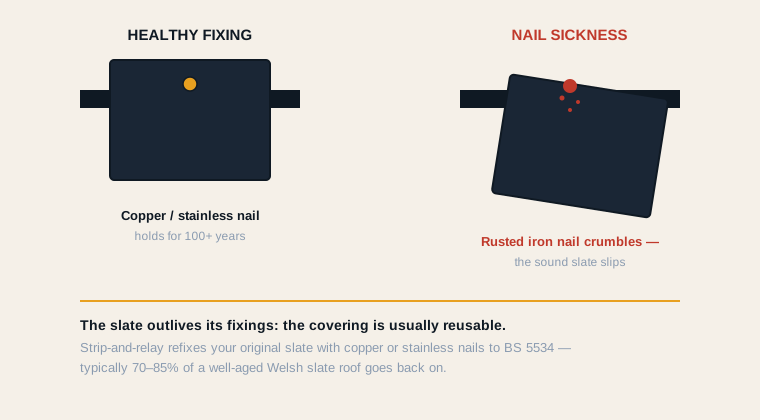
Most of Reading’s housing — the 1958-90 estates of Whitley, Southcote, Woodley and Lower Earley — was built with concrete interlocking tiles, and that is exactly what they should be re-roofed with. Concrete is cheaper, the interlocking design is quick to lay, and a 40-60 year life is more than enough for the stock. The one caveat is the reason these roofs need doing at all: the original iron nails fail (nail sickness) long before the tiles themselves, which is why a 1965 Whitley roof needs re-roofing now even though the tiles look intact. A modern concrete re-roof with proper fixings solves that for good. See our roof replacement and new roof cost guides for the full picture.
Why Clay Suits Reading’s Period Homes
Reading’s Victorian and Edwardian stock — the terraces of Newtown and Katesgrove, the villas of Caversham, the cottages of the conservation villages — was built with clay plain tiles or natural slate, and matching that matters both visually and, in conservation areas, legally. Clay holds its warm colour for its entire 80-150 year life rather than fading like concrete, and its smaller format suits the steeper pitches and detailing of period roofs. On these properties, dropping concrete onto a Victorian terrace looks wrong and can breach conservation-area requirements. Clay costs more up front, but on a house that keeps the tile for a century, the cost-per-year is often lower.
BS 5534, the British Standard for slating and tiling, governs the fixing specifications for both concrete and clay tiles — and modern re-roofs to this standard use mechanical fixings (clips and screws) precisely to avoid the nail-sickness failure that ages Reading’s original concrete-tile estate roofs.
Not sure which is right for your roof? A local Reading roofer will talk it through — free, no obligation.
📅 Get My Free Quote 📞 Call 0118 327 2383The Honest Verdict
If you own a post-war estate house in Reading, concrete interlocking tile is almost always the right re-roof — it matches the stock, meets the budget, and a properly-fixed modern concrete roof will outlast your ownership. If you own a Victorian, Edwardian or conservation-area property, clay (or slate) is usually the right answer, sometimes the required one, and the higher cost buys a roof that holds its looks for generations. The genuine grey area is a period house outside a conservation area on a tight budget — there, a good concrete plain tile can be a sensible compromise. We survey your specific property and tell you honestly which makes sense, including whether conservation rules apply.
Cost-Per-Year: The Honest Maths
Headline price favours concrete — a concrete re-roof on a Reading semi runs several thousand pounds less than clay. But over the life of the roof the gap narrows. A concrete roof lasting 50 years and a clay roof lasting 100 years work out closer on cost-per-year than the sticker prices suggest, and clay holds its colour throughout while concrete can fade. For an estate house you may sell within 20 years, concrete’s lower up-front cost is the sensible call. For a period home you intend to keep, or pass on, clay’s longevity and looks often justify the premium. Neither is "overpriced" — they suit different properties and different time horizons, and we help you weigh which applies to you.
Whatever you choose, the fixing spec matters more than most homeowners realise. A modern re-roof to BS 5534 with mechanical clips and screws is what prevents the nail sickness that aged your original roof — so a properly-fixed concrete roof today is a very different proposition from the iron-nailed concrete of the 1960s that is now failing across Reading.
Common Questions
It depends on your property. Concrete suits Reading post-war estates (Whitley, Southcote, Earley) on cost and match. Clay suits period and conservation stock (Newtown, Caversham, villages) and is sometimes required there.
Concrete tiles last 40-60 years, clay tiles 80-150 years. On both, the fixings often fail before the tile, which is why modern re-roofs use mechanical clips to BS 5534.
On a period property, usually yes - clay holds its colour for its whole life and suits the stock, so the cost-per-year can be lower than concrete despite the higher upfront price.
Outside a conservation area you can, and on a tight budget a good concrete plain tile can work. In a conservation area, matching clay or slate is often required. We advise per property.
Nail sickness - the original iron nails fail long before the concrete tiles do. On Reading 1958-90 estate roofs the tiles can look intact while the fixings have gone, causing repeated slips.
Concrete is heavier than clay, but Reading estate roofs were designed for it. On a period roof originally built for lighter clay or slate, we check the structure before specifying concrete.
Yes - both, matched to your property era and any conservation requirements, fixed to BS 5534 with a 10-year workmanship guarantee.
Get Re-Roofing Advice
0118 327 2383📅 Or Book a CallbackLast updated: August 2026