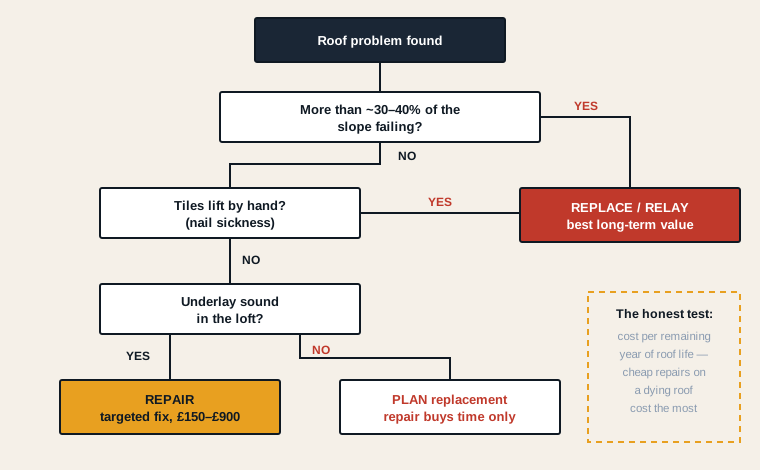
The honest decision framework for Reading homeowners — when patching an ageing roof is money well spent, and when it is throwing good money after bad. Written by roofers who will tell you to repair when repair is right.
Tell us the job in 30 seconds. No pushy sales, no call-out fee.
📞 Call Now: 0118 327 2383Repair your roof if the damage is localised and the rest of the covering is sound — a few slipped tiles, one failed flashing, a single valley. Replace it if failure is widespread: nail sickness across a 1960s-70s estate roof, multiple leaks in separate areas, or a covering past 50-60 years old. The rule of thumb: if repairs would cost more than about 30% of a re-roof and the roof is near the end of its life, replace.
Almost every repair-or-replace decision comes down to one question: is the problem confined to one part of the roof, or is the whole covering reaching the end of its life? A slipped tile on an otherwise sound roof is a repair, every time. But when a Reading homeowner tells us tiles are slipping in different places after every windy spell, that is rarely bad luck — it is usually nail sickness, and it is a whole-roof problem.
The honest framework we use, and the one you can apply yourself, weighs four things: the age of the covering, the pattern of failure, the cost of repair against the cost of replacement, and how many more years you need the roof to last.
Roofing materials have predictable lifespans, and Reading's housing tells you roughly where a roof sits. Concrete interlocking tile — the standard on the post-war estates of Whitley, Southcote, Woodley and Lower Earley — lasts 40-60 years, but the iron nails fixing it fail sooner, which is why nail sickness hits this 1958-1990 stock first. Clay plain tile, on the Victorian terraces of Newtown, Katesgrove and Caversham, lasts 80-150 years. Natural slate on Edwardian villas lasts 80-120 years.
So a 1965 Whitley semi on its original concrete tile is at the age where whole-roof nail sickness is likely — replacement territory. A Victorian Newtown terrace with its original clay is probably good for decades more, and a leak there is almost always a repair. The stock era is the fastest first indicator of which conversation you are having.
The money test is simple. Work out what the repairs would cost, and what a full re-roof would cost. If the repair is a small fraction of the re-roof and buys you several years, repair. If the repair approaches 30% or more of a re-roof and the roof is near the end of its life anyway, replacement is better value — because you are paying a third of the cost for a fraction of the remaining life.
Think of it as cost per remaining year. A £600 repair that buys two years on a failing roof costs £300 a year. A £7,000 re-roof that lasts 50 years costs £140 a year. On a genuinely failing roof, replacement is often the cheaper option over time, not the more expensive one — which is the opposite of most people's instinct.
The trap is the roof that needs a repair every year. Three £500 repairs across three years on a nail-sick Whitley roof is £1,500 spent delaying an £8,000 re-roof — and the roof is no better at the end. That is when patching is money wasted.
RICS and BRE stock-condition guidance both frame roof replacement decisions around remaining serviceable life rather than one-off defects — the principle that a roof near the end of its life is better replaced than repeatedly patched, because each repair buys diminishing time against the eventual full cost.
This works both ways, and E-E-A-T cuts both directions. A roofer who tells every caller their roof needs replacing is not being honest — they are selling. If your covering is fundamentally sound and the problem is one failed area, a re-roof is oversell. A single failed flashing, one slipped section, a localised valley failure — these are repairs, and anyone quoting a full re-roof for them should be questioned.
We turn down re-roof work regularly. A Caversham homeowner recently asked us to quote a full replacement after a doorstep trader told them their roof was "finished." On survey it had a good ten years left and needed the ridge repointing — a few hundred pounds, not several thousand. We said so. That is the standard: the honest answer, even when it is the smaller job.
Ready to talk it through? A local Reading roofer will call you back within 2 hours.
📅 Get My Free Quote 📞 Call 0118 327 2383If you are genuinely unsure, a proper roof survey settles it. We inspect from roof level, check the fixings and underlay, and give you a written report that tells you honestly where the roof sits — repair, replace, or leave it and monitor. If you are buying a property in Reading, a pre-purchase survey does the same before you commit, and often pays for itself many times over in price negotiation.
Whatever the answer, you get it in writing, with an itemised cost, and no pressure. Read our full guide to how we work, or our guide to choosing a roofer in Reading without getting stung.
The repair-or-replace question is not always binary. Sometimes the honest answer is a partial re-cover — stripping and re-covering one slope or one elevation while leaving sound slopes alone. This comes up often on Reading's larger detached and semi-detached stock, where a south-facing or weather-exposed slope has failed while a sheltered north slope has years left. Re-covering the failed slope alone can be the right-value decision: more than a patch, less than a full re-roof.
The same logic applies to the exposed Tilehurst and Caversham Heights properties that take the prevailing south-westerly on one face. We assess each slope on its own merits rather than defaulting to "repair everything" or "replace everything." That is only possible with a proper roof-level survey — from the ground, every roof looks like a full re-roof or a quick patch, and neither is usually true.
Get the repair-or-replace decision wrong in either direction and it costs you. Repair a genuinely failing roof and you are on a treadmill of annual call-outs, each one buying less time than the last, while water quietly damages battens, timbers and ceilings between visits — turning a roof problem into a structural one. Replace a sound roof unnecessarily and you have spent several thousand pounds you did not need to, decades early.
This is why the honest survey matters more than the quote. A roofer motivated to sell a re-roof will find reasons for one; a roofer motivated to sell repeat repairs will keep patching. Our position is deliberately neutral: we quote the work the roof actually needs, we put the reasoning in writing, and we are equally willing to talk you out of a re-roof as into one. Over 20 years in Reading, that reputation is worth more to us than any single oversold job.
Related guide: Concrete vs clay tiles →
Repair if the damage is localised and the rest of the roof is sound. Replace if failure is widespread - nail sickness across an estate roof, multiple separate leaks, or a covering past 50-60 years. The rule of thumb: if repairs approach 30% of a re-roof cost and the roof is near the end of its life, replace.
Concrete interlocking tile (post-war estates) lasts 40-60 years, though the nails fail sooner. Clay plain tile (Victorian Newtown, Caversham) lasts 80-150 years. Natural slate lasts 80-120 years. The fixings usually fail before the tiles, which is why nail sickness hits the 1958-1990 concrete stock first.
A rule of thumb: if the cost of repairs approaches 30% or more of the cost of a full re-roof, and the roof is near the end of its serviceable life, replacement is better value. Below that, and on a roof with years left, repair.
On a sound roof with a localised fault, repair is far cheaper. On a genuinely failing roof, replacement is often cheaper over time - a re-roof that lasts 50 years can cost less per year than repeated annual repairs that fix nothing permanently.
When the covering is sound and only one area has failed - a single flashing, one slipped section, a localised valley. Anyone quoting a full re-roof for a localised fault should be questioned. A single slipped tile is never a re-roof.
A roof-level survey settles it. We give you a written report - repair, replace or monitor - with an itemised cost and no pressure. For a purchase, a pre-purchase survey does the same before you commit.
Not immediately - it is usually a plan-ahead problem, not an emergency. But on a 1958-1990 concrete tile estate roof where tiles are slipping in multiple places, it is a whole-roof issue, and repeated repairs cost more over time than a planned re-roof.
Last updated: August 2026