EPDM vs GRP Flat Roofing
Rubber or fibreglass for your Reading flat roof? An honest comparison of EPDM and GRP — cost, lifespan, install and which suits a garage, extension or warm-deck conversion.
Tell us the job in 30 seconds. No pushy sales, no call-out fee.
📞 Call Now: 0118 327 2383EPDM (rubber) and GRP (fibreglass) are both excellent flat-roof systems. EPDM is a single rubber sheet — quick to fit, flexible, forgiving on movement, and installable in most weather, ideal for garages and simple shapes. GRP is a seamless laminate — harder-wearing underfoot and crisp on complex shapes, but needs dry, mild conditions to cure. For most Reading garage and extension roofs either works; the deck condition and roof shape usually decide it.
EPDM vs GRP Compared
| EPDM (rubber) | GRP (fibreglass) | |
|---|---|---|
| What it is | Single rubber membrane | Glass-fibre laminate + resin |
| Typical lifespan | 30-50 years | 25-30 years |
| Finish | Matte rubber, slight give | Hard, seamless, walk-on |
| Weather to install | Most conditions | Dry, mild only (curing) |
| Best for | Garages, simple shapes, movement | Complex shapes, foot traffic, balconies |
| Typical garage cost | £800-£1,600 | £1,000-£2,000 |
| Joints | Bonded seams | Fully seamless |
Both are a huge step up from old-style felt, which is why we rarely re-felt a Reading flat roof any more. The choice between them is about roof shape, use and budget — not one being simply "better".
Choose EPDM If...
EPDM (rubber) is the pragmatic choice for most Reading garage and extension roofs. It goes down as a single sheet with very few joints, flexes with the building’s movement without cracking, and — crucially in the Thames Valley — can be laid in most weather rather than waiting for a dry, mild spell. On a straightforward rectangular garage roof, EPDM is quick, cost-effective and lasts 30-50 years. It is slightly softer underfoot, so for a roof that is only ever accessed for maintenance, that is a non-issue.
Choose GRP If...
GRP (fibreglass) earns its place where the roof is walked on regularly — a balcony, a roof terrace, a dormer cheek — or where the shape is complex with lots of upstands, angles and detail. The resin-and-matting system forms a completely seamless, hard-wearing surface that takes foot traffic well and looks crisp on intricate geometry. The trade-off is that GRP must be laid and cured in dry, mild conditions, so we weather-plan fibreglass jobs; rushing it in the damp gives a poor finish.
Both EPDM and GRP, correctly installed, comfortably outlast the 15-20 year life of traditional built-up felt — which is why modern flat-roof best practice, reflected in NFRC guidance, has moved decisively away from re-felting toward single-ply and liquid systems.
Not sure which is right for your roof? A local Reading roofer will talk it through — free, no obligation.
📅 Get My Free Quote 📞 Call 0118 327 2383It Usually Comes Down to the Deck
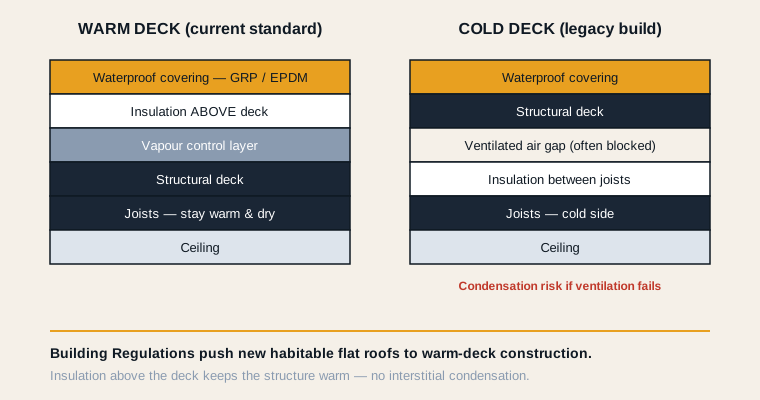
Here is what most comparisons miss: the single biggest cost driver on a flat-roof replacement is not the membrane, it is the condition of the timber deck beneath. If the deck is sound, either system goes straight over it. If the deck has rotted — common on neglected felt garages across Reading’s estates — it needs replacing first, and that is the same cost whichever membrane you then choose. On a warm-deck conversion (turning a cold garage into a habitable room), insulation is added above the deck, which is where our flat roofing service and the warm-deck build-up in the diagram above come in. We always survey the deck before quoting, because it changes the numbers more than the EPDM-versus-GRP decision does.
Which Is Cheaper in the Long Run?
Up-front price is only half the story on a flat roof. EPDM costs a little less to install and lasts 30-50 years, so its cost-per-year is genuinely low. GRP costs slightly more and lasts 25-30 years, but its hard-wearing surface means it rarely needs attention where foot traffic is involved. Neither needs the recurring patch-and-repair that old felt roofs demand, which is where felt quietly becomes the most expensive option of all despite the cheapest start. Across a typical Reading garage or extension, the EPDM-versus-GRP cost difference over the life of the roof is small — which is why we steer the decision on roof shape and use rather than headline price.
One real cost variable to plan for: if your existing flat roof is old felt with a rotten deck, budget for deck replacement whichever membrane you choose. We survey the deck first and quote it separately so there are no surprises, and we will always tell you honestly if the deck is sound and can simply be overlaid.
Common Questions
For a simple rectangular Reading garage roof, EPDM is usually the better value - quick to fit, installable in most weather, and lasting 30-50 years. GRP suits complex shapes or roofs that are walked on.
EPDM typically lasts 30-50 years and GRP 25-30 years, both correctly installed. Both comfortably outlast traditional felt. Lifespan depends heavily on installation quality and the deck beneath.
Usually slightly, yes - a GRP garage roof runs around 1,000-2,000 pounds versus 800-1,600 for EPDM. The gap narrows on complex roofs where GRP is the more suitable system anyway.
EPDM can be laid in most conditions, which is an advantage in the Thames Valley. GRP needs dry, mild weather to cure properly, so we weather-plan fibreglass jobs.
Only if the timber deck has rotted, common on old felt garages. If the deck is sound, either membrane goes straight over it. We survey the deck first, as it is the biggest cost variable.
GRP - its hard, seamless surface takes regular foot traffic better than EPDM. For a maintenance-only roof, EPDM is fine and often cheaper.
Yes - we fit both across Reading and advise honestly on which suits your roof shape, use and budget rather than pushing one system.
Get the Right System for Your Roof
0118 327 2383📅 Or Book a CallbackLast updated: August 2026